
Análise da mecânica da banda de degraus da escada rolante
By Dr. Ali Albadri | Engenharia | 31 de julho de 2026
Tempo de leitura: 4 minutos
Heavy-duty escalators built for heavy passenger density, high rise and long daily operation expose step bands to far greater stresses than light-duty units. Two chains carried on top and idler shafts maintain step spacing under carriage-applied tension, but uneven loading such as a stand on the right habit causes one chain to bear higher force, accelerating wear, inducing step skew, chain kinks and dangerous interactions at comb plates. Larger chains and taller rises amplify these effects, while step rotation at return tracks adds further stress. Steps with cross axles isolate differential forces better than stub axles. Continuous single-direction running worsens wear. Smart monitoring and a redesigned carriage promise improved maintenance, safety and lifecycle costs.
Com foco em escadas rolantes para serviço pesado
Por Dr. Ali Albadri
The step band in a heavy-duty escalator is subjected to high stresses and strains compared to the step band in a light-duty escalator. Heavy-duty escalators are designed and built for public transport systems. They deal with a heavy passenger density, particularly during the rush hour peaks and also when special occasions occur (state visits, parades, etc.). They have a high rise (10 m-plus), and they work for long hours, typically 20 h a day.
An escalator consists of two shafts; top and idler shafts (see Figure 1). The top shaft is driven by a chain connected to a motor through a gearbox. The idler shaft is placed in a carriage pulled linearly against the trusswork using spring and tension rod mechanism.
As the carriage is pulled backward, it keeps the chains/step band under continuous tension.
The step band in a heavy-duty escalator is subjected to more forces, stresses and strains than the step band in a light-duty escalator. Policy like "Stand on the right" does not encourage uniform wear in the chains over the width of the machine as one chain is subjected to higher force, thus wear, than the other chain.
The chains in the step band enable the steps to maintain safe and practical clearances between each other and between the steps and the skirting. The chains in a heavy-duty escalator are much larger than those in a light duty escalator. They have wheels located at a pitch distance approximately equal to the width of the step. The two chains are linked with a cross axle where the steps are hinged. The steps are free to rotate around the axle as shown in Figure 2.
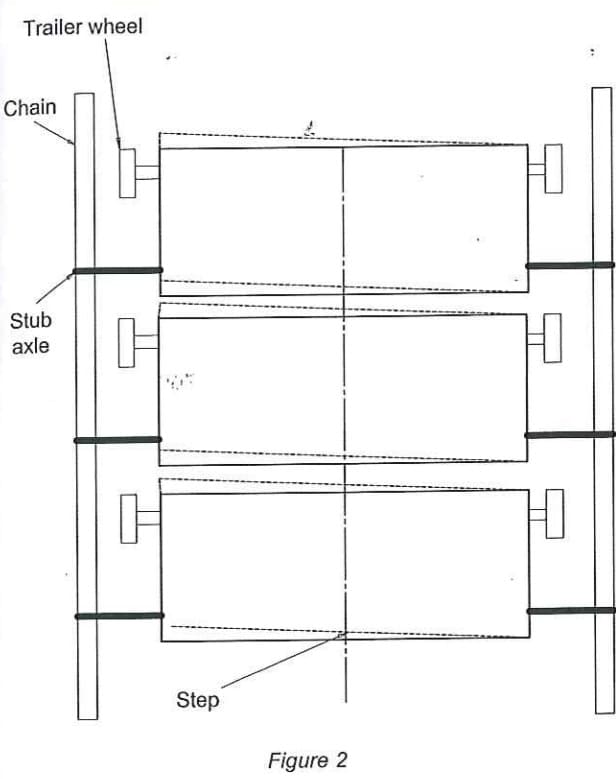
The chains are carefully matched in length and accuracy when they are new. The two chains run with high precision on the two sprockets for the top and idler shafts (see Figure 1). The high precision between the chains and the sprockets ensure the steps remain correctly aligned to each other and always in perpendicular orientation to the centerline of the machine.
The carriage in the bottom landing is where the idler shaft is placed to keep the chains in continuous tension. The tension force should be equal in both chains, but in reality, this does not happen during the operation of the escalator. The loads imposed by passengers are not applied uniformly (stand on the right policy) over the step band. This causes one chain on one side to be under higher force than the other side, resulting in high wear and increases in the accurately machined tolerances and clearances of the bushes in the chain. High wear in one chain allows the steps to skew to one side of the machine. The larger the chains for the higher the rise of the escalator means the worse the wear, which causes more skew in the steps. The skewing problem becomes serious when the misaligned steps try to pass through the comb plates. This can have safety implications for passengers especially when considering the possibility of the step hitting the comb plate or the steps colliding with each other.
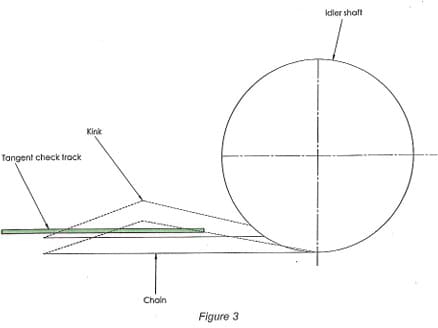
High wear in one chain can cause the chain to have a kink, especially as it comes out of teeth on the idler sprocket (see Figure 3). The creation of a kink generates significant stresses in the chain and the steps. Tangent check track can stop the chain by force from kinking. The chain is forced to stay in a horizontal position, and however, the force on the steps and chain could remain high.
In the space between the lower landing and bottom sweep of the return side, the steps rotate to accommodate the differences between the heights of the tracks. These differences allow the steps to tilt on an angle to ease their movement at the top sweep return side. This maneuver subjects the steps to additional stresses.
The impact of wear in the chains has highlighted the wide contrast between steps with stub axles and steps with cross axles. In the step with stub axle, each side of the step is affected by the amount of wear in the chain nearby. Therefore, the body of the step will take the burden of accommodating the differential in the forces at both sides of the step.
The steps with chain axle do not expose the body of the step to differential force as the axle absorbs the differential force.
Running a high-rise escalator for a long time in the up or the down direction does make chain wear more of a problem than frequently reversing the escalator.
Frequent use of monitoring devices like the smart step and chain differential can have significant and positive contribution in identifying the critical locations along the escalator, especially during planning maintenance schedules.
The coming articles in the series will disclose more facts and technical data that will expose what happens inside an escalator — especially the heavy type. A new design concept for the carriage will be proposed that could revolutionize the escalator industry. All this will have valuable benefits in keeping escalators in good operating conditions, control maintenance schedules, reduce refurbishment costs, improve safety and most importantly allow the designer to understand what is going on in an escalator.

MAIS DA CATEGORIA
NOTÍCIAS DIÁRIAS