
Assembleia Geral e Conferência da ELA 2026
By Sascha Göbel | Eventos | 31 de julho de 2026
Tempo de leitura: 8 minutos
Rotterdam hosted the European Lift Association General Assembly and an AI conference that reframed vertical mobility around software and data. Delegates adopted budgets and prepared for the shift to EN ISO 8100-1/2:2026 while speakers warned that AI is already embedded in operations, bringing opportunities in predictive maintenance, design acceleration and RegTech but also novel risks: faster, scalable cyberattacks via cloud and apps, AI hallucinations and context drift undermining safety. Panelists urged action rather than recipes, highlighted forthcoming Machinery Regulation enforcement from January 20, 2027 and relevant standards, and stressed workforce training, awarding ROVC for skills development. The verdict was clear: get curious and begin.
Entre o poço e o servidor: cúpula de IA no rio Maas, em Roterdã
por Sascha Göbel, correspondente da EW
Rotterdam, Netherlands, draws its identity from steel, glass and the relentless pulse of its world port. In late May, the city offered a fitting backdrop for the institutional heart of the European lift industry. For your author, attending the General Assembly (GA) of the European Lift Association (ELA) and the conference that followed was a first — a journey that began on the water and led deep into the questions of a digital future.
Behind the Doors of the General Assembly
On May 27, the delegates gathered at the DoubleTree by Hilton for the members’ assembly. The agenda covered the presentation of the results of all ELA committees, the report of the Management Board and the adoption of the 2026 budget.
The normative backdrop is the transition to EN ISO 8100-1/2:2026, which — published in spring 2026 — is set to replace the current standards EN 81-20/-50. And there lie the bridge to the second day: Regulation is catching up with digitalization, too — and the industry has to respond.
An Evening to the Rhythm of the Maas
But before standards and algorithms took the floor, the Dutch association VLR hosted an evening that made the industry’s international character tangible. A boat tour through the port of Rotterdam with excellent food and fine company: An ideal setting for the kind of informal exchange that appears on no agenda and yet matters most. Between the glittering skyline and the gentle sway of the Maas, contacts were deepened — visible, for instance, in the delegations that had traveled from across Europe, from VFA-Interlift to the British Lift and Escalator Industry Association (LEIA). Warm thanks go to the hosts for this atmospheric prelude.
The AI Conference: More Questions Than Answers?
The second day, moderated by Marjon Oosting (Liftinstituut), was devoted entirely to the theme “The Impact of AI on Vertical Mobility and Safety.” Across 10 presentations, the conference delivered clear messages for different profiles: For the beginners, “Get started!;” for the sceptics, the disarming reminder: “You are already using it today;” and for the doubters in the security camp, the unambiguous warning, “You can do nasty things with AI ...” The aim was explicitly not to hand out ready-made recipes, but to send participants home “with more questions” than they had when they arrived.
The common thread across all the contributions: AI is no longer an optional technology trend; it shifts the competitive advantage away from purely mechanical excellence toward the ability to translate data streams into safety-relevant and operational intelligence. “Software-defined vertical mobility” is no longer a buzzword, but day-to-day business.
Opening: "European Approach to AI"
The opening was set by Mihaela Lafont of the European Commission, with a framing of European AI policy. Joining online, she set the tone for the day from a regulatory and strategic perspective.
Keynote: "Understanding AI and Shaping What Comes Next"
Next came Rommy van de Pol (Innovation and AI at nlmtd). Her message: AI is already reality and quietly steers our everyday lives — from facial recognition to spam filtering. She traced the historical arc from the Turing test (1950) through Deep Blue (1997) and AlphaGo (2016) to the breakthrough of ChatGPT in November 2022. The speed of adoption, she argued, is unprecedented: Where classic platforms took years to build their user base, ChatGPT reached its millions within days. For companies, that means a competitive advantage can now erode in months rather than years.
Van de Pol assessed the technology soberly. Its strengths lie in drafting and summarizing technical documentation, in spotting patterns and anomalies in sensor data and in explaining complex system states in accessible terms. Its weaknesses are just as real: hallucinations — plausible-sounding but factually wrong statements — a lack of awareness of physical consequences and a static data basis with no real-time link. Her closing line became the conference's leitmotif: "The train has left. Are you on it?" and the appeal: "Get curious. Begin."
How concretely this ambition translates into development was shown next by Jo Tetsill, under the title "Accelerating Design and Quality in Elevators Through AI" — AI not as a thing of the future, but as a tool in the design and quality process.
"Hacking the Vertical": The Machine Room Is Open
The sharpest contrast was delivered by the Sopra Steria Red Team. Alwin Warringa and Tom Danturna demonstrated that, in the age of connected installations, the physical protection of the machine room has lost its meaning — the risk today is globally scalable. Used control boards from online marketplaces served attackers as cheap research labs; mobile apps opened, as a "front door," access to entire cloud fleets; vulnerabilities in cloud interfaces multiplied an attack across thousands of units within seconds. Even reading out chips — once the preserve of specialist labs — is now possible with hobby equipment for around €2,000 (US$2,321).
Crucially, the team noted, AI does not change the type of attacks, but their speed. What used to take weeks — analyzing how a device works — now succeeds in hours; developing an exploit shrinks from days to minutes; and social engineering moves from generic mass mailing to highly personalized targeting. The lesson for the industry: Trust will, in the future, be built in the software, no longer in the hardware — and one must assume that one's own products will be dissected in detail by third parties via the secondary market.
"Silver Bullet or Heuristic Machine?": When the AI Itself Becomes the Weak Point
Tijmen Molema (Liftinstituut) turned the focus to a subtler danger: the "silver bullet" syndrome — the blind trust in AI-generated answers. Particularly critical, he argued, is “context drift”: Attackers can manipulate the interaction history of an AI system so that its safety filters erode piece by piece. For AI-based safety logic, this is a novel kind of threat: The system can be pushed into an unsafe state without any classic logic error occurring. Where determinism was once the foundation of functional safety, a gray zone now emerges that the familiar testing methods cannot fully capture.

“AI and Safety – Regulation and Standardization”: The Standards Catch Up
Frank Roussel linked the safety theme to the standardization perspective. For the development of AI-based safety functions, specific standards move into the mandatory zone: the IEC 62443 series for cybersecurity in industrial automation, the lift-specific ISO 8102-20 and IEC 61508 for the functional safety of electronic systems. The real challenge, he argued, lies in designing non-deterministic AI systems so that they nevertheless meet the strict requirements for embedded, safety-relevant software — a balancing act that will occupy the industry all the more with the forthcoming Machinery Regulation (EU) 2023/1230 (binding from January 20, 2027).
“How AI Is Changing the Way Industries Understand Regulation”: AI as RegTech
Constance Girard reversed the perspective: AI is not only a subject of regulation, but becomes a tool to master it. As “RegTech,” it helps to make the sheer volume, speed and fragmentation of regulatory information manageable through targeted signal extraction. Companies, she argued, will have to keep both the European AI Act and the Machinery Regulation in view in parallel — and precisely this complexity, as Girard pointed out, can be addressed with the very technologies that helped create it.
Efficiency, Twins, Robots: The Application Side
That AI creates tangible business value was illustrated by a contribution on the intelligent building platform EcoStruxure from Schneider Electric. The presentation introduced a software-defined architecture of connected sensors, local edge control and cloud-based analytics. According to the company, predictive control of heating, ventilation and air conditioning in a project across 624 school buildings reduced heating energy demand by 4% — with one degree more comfort — cut electricity consumption by 15% and saved around 205 T. of $CO_2$; the investment, it said, pays for itself in about two years.
Two further contributions rounded off the application side: Luka Obuljen addressed digital twins for predictive maintenance and design optimization, and Rahel de Vriend explored where investment in lift robotics is flowing — and what that means for the industry.
The Human Factor: "Better Skills. Better Future."
The arc back to people was drawn by Waldo Linders and Emil van Hoffen (ROVC). Technological leaps, they argued, are only as effective as the skilled workers who command them. Van Hoffen framed his appeal with a remark attributed to Henry Ford — the future of technology depends on the people we train today. I followed with particular interest the activities aimed at qualifying lift specialists drawn from other occupations: Career changers are brought up to speed for the lift industry in modular form.
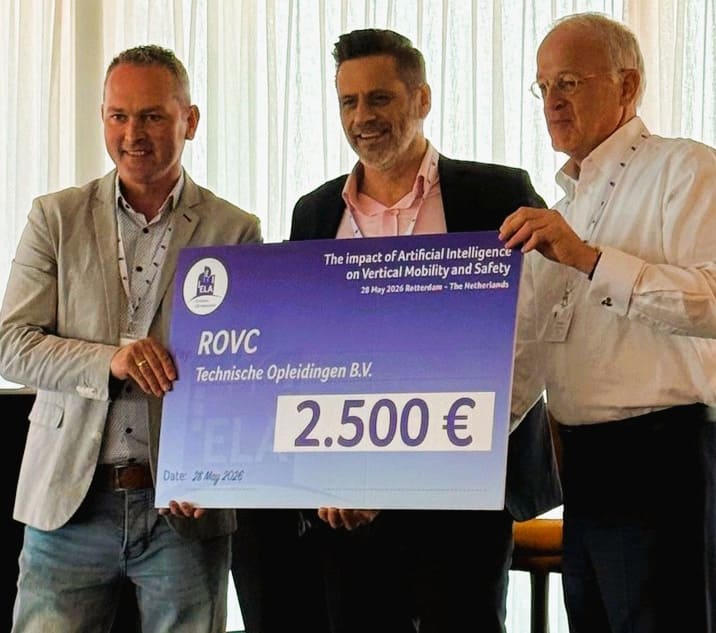
This message found its institutional counterpart: The ELA Award went to ROVC Technische Opleidingen — a technical training institute whose recognition, in an industry marked by a skills shortage, is more than a gesture. Here, recognition becomes investment — a “large” check was handed over.
Conclusion: Between Shaft and Server
The days in Rotterdam showed that the industry is not waiting out the digital transformation but actively shaping it. Classic lift safety is being augmented by digital requirements — driven by new standards and a regulatory framework that, from 2027, makes AI and cybersecurity mandatory considerations. At the same time, the threat model is shifting from the local machine room to the global cloud, and the value of an installation is increasingly measured by the intelligence of its software.
I left Rotterdam with the sense of standing at a turning point. We are not only headed home to look for answers, but to carry the right questions into our daily work, into the expert circles and into the standardization committees. Or, in the leitmotif of Rommy van de Pol: Get curious. Begin.
“Glück auf” for the road between shaft and server!
Num relance
Venue: DoubleTree by Hilton Rotterdam Centre
Date: General Assembly, May 27; Conference, May 28
Theme: “The Impact of AI on Vertical Mobility and Safety”
Evening host: VLR | Liften en Roltrappen
Conference moderator: Marjon Oosting (Liftinstituut)
ELA leadership: Wim Koster (President), Luca Pezzini (Secretary General), Gaëtane Van Laethem (Organization)
Award: ELA Award to ROVC Technische Opleidingen
Regulatory context: EN ISO 8100-1/2:2026; Machinery Regulation (EU) 2023/1230 (from Jan 20, 2027); cyber standards IEC 62443, ISO 8102-20, IEC 61508
International delegations (among others): VFA-Interlift (Christella Herzog, Peipei Wang, Achim Hütter), LEIA (George Jackson, Laura Webb, Micky Grover-White)
MAIS DA CATEGORIA
NOTÍCIAS DIÁRIAS