
التحديث الاستراتيجي للسلالم المتحركة القديمة: إطار هندسي لإطالة عمرها التشغيلي
By Byju Kannampalli | تحديث | يوليو 31 ، 2026
دقيقة واحدة للقراءة
استمع إلى هذه المقالة
Thousands of aging escalators can often be extended through strategic partial modernization rather than default replacement. An engineering-first framework evaluates each subsystem independently against EN 115 guidance, distinguishing structurally sound trusses from worn controllers, chains, brakes and electrical systems. The proposed Decision Pyramid prioritizes interventions from cosmetic and safety upgrades through performance and reliability improvements to major renewals, reserving full replacement for structural failure or when life-cycle analysis justifies it. Targeted modernization reduces downtime, preserves asset value, meets evolving safety requirements, improves operational performance and lowers total cost of ownership by replacing only what is necessary and preserving what continues to perform.
لماذا لا يُعد الاستبدال الكامل دائمًا الحل الهندسي الأمثل؟
by Byju Kannampalli
الملخص
As thousands of escalators installed during the construction boom of the 1990s and early 2000s continue to age, building owners are increasingly faced with the decision of whether to modernize existing equipment or proceed with complete replacement. While replacement is often regarded as the default solution, detailed engineering assessments frequently demonstrate that many escalators retain structurally sound core components capable of providing many additional years of safe and reliable service.
This article presents an engineering framework for evaluating aging escalators based on the condition of individual subsystems rather than chronological age alone. It discusses the principles of strategic partial modernization, identifies the key components requiring technical assessment and proposes a structured decision-making approach that balances safety, reliability, operational continuity and life-cycle cost. The objective is to encourage engineering-led modernization strategies that maximize asset value while minimizing unnecessary replacement.
المقدمة
Across the world, a significant proportion of installed escalators are approaching the stage at which major capital investment decisions become unavoidable. Increasing maintenance requirements, aging electrical systems, evolving safety standards and the gradual obsolescence of replacement components often prompt recommendations for complete equipment replacement.
While complete replacement is appropriate in certain situations, it should not be regarded as the default solution for every aging escalator. An escalator is a complex assembly of structural, mechanical, electrical and safety systems, each operating under different service conditions and each having its own expected service life. These systems rarely deteriorate at the same rate. Consequently, the overall age of an escalator is not, by itself, a reliable indicator of its remaining service potential.
For building owners, the decision extends beyond the cost of new equipment. Complete replacement may require prolonged shutdowns, significant demolition work, structural modifications, interruption of pedestrian circulation and disruption to commercial operations. In facilities such as shopping malls, airports, metro stations, hospitals and commercial buildings, the indirect costs associated with operational downtime can be as significant as the capital investment itself.
For consulting engineers and modernization specialists, the challenge is therefore to determine whether complete replacement is technically justified or whether a carefully planned modernization program can restore safety, improve reliability, extend operational life and deliver greater long-term value.
This article examines the engineering principles that should guide that decision. It proposes a structured methodology for assessing aging escalators, evaluating the condition of individual subsystems and identifying modernization strategies that optimize both technical performance and life-cycle value. Rather than treating replacement as the starting point, the article advocates an engineering-first approach in which every major investment decision is supported by objective technical evaluation and sound asset management principles.
Engineering Assessment Framework for Escalator Modernization
The success of any escalator modernization project depends on the quality of the initial engineering assessment. Decisions based solely on equipment age often result in unnecessary replacement of serviceable components, while overlooking systems that genuinely require renewal. A structured technical evaluation enables modernization strategies to be developed on the basis of actual equipment condition, operational requirements and life-cycle value.
Internationally, modernization assessments are generally guided by the principles of EN 115-1 Safety of Escalators and Moving Walks — Construction and Installation and EN 115-2 Rules for the Improvement of Safety of Existing Escalators and Moving Walks, together with manufacturer recommendations and applicable local regulations. These standards promote a risk-based approach, encouraging targeted improvements that enhance safety and reliability without unnecessarily replacing structurally sound equipment.
Unlike many building systems, the major components of an escalator do not reach the end of their service life simultaneously. The structural truss may remain serviceable for several decades, while controllers, drive components, safety devices and electrical systems may require modernization much earlier. Consequently, each subsystem should be evaluated independently before determining the appropriate level of intervention.
The engineering assessment should address the principal subsystems shown in Table 1.
| النظام الفرعي | Primary Assessment Criteria | Typical Modernization Strategy |
| Structural Truss | Structural integrity, corrosion, deformation, weld condition, support arrangement | Preserve where structurally sound; reinforce or repair where necessary |
| نظام الدفع | Motor, gearbox, brake, bearings, sprockets, lubrication, vibration | Renew worn mechanical components selectively |
| مراقب | Obsolescence, reliability, diagnostics, spare-part availability | Replace with microprocessor controller and variable-frequency drive (VFD) |
| Step Chain and Drive Chain | Elongation, roller wear, alignment, tension | Replace when wear exceeds manufacturer limits |
| خطوات | Structural cracks, cleat wear, roller condition, axle wear | Selective replacement of damaged steps |
| نظام الدرابزين | Surface condition, tracking, tension, synchronization | Replace worn handrails and adjust drive system |
| Balustrade Assembly | Glass integrity, skirt clearance, alignment, decking condition | Refurbish and correct alignment defects |
| أجهزة السلامة | Functional testing, code compliance, operational reliability | Upgrade in accordance with EN 115-2 recommendations |
| التركيبات الكهربائية | Wiring, grounding, protective devices, documentation | Renew obsolete electrical systems and improve maintainability |
This subsystem-based assessment provides a clear technical understanding of the escalator’s actual condition and enables engineers to distinguish between components that require immediate replacement and those capable of providing many additional years of reliable service.
Rather than viewing modernization as a single intervention, the assessment establishes the technical foundation for selecting the most appropriate modernization strategy. The objective is not to replace the maximum number of components, but to restore safety, reliability and performance while preserving assets that continue to provide engineering value.
The Escalator Modernization Decision Pyramid
Escalator modernization should not be viewed as a choice between routine maintenance and complete replacement. Instead, it should be regarded as a structured engineering process in which each level of intervention is evaluated according to the condition of the equipment, operational requirements, applicable safety standards and life-cycle objectives.
To support this approach, your author proposes the Escalator Modernization Decision Pyramid — a practical engineering framework for determining the appropriate level of modernization before considering complete replacement.
Escalator Modernization Decision Pyramid
The pyramid illustrates a simple but important engineering principle: Modernization should progress from the least intrusive interventions to the most extensive. Each level should be fully evaluated before moving to the next. Complete replacement therefore becomes the final engineering option rather than the default starting point.
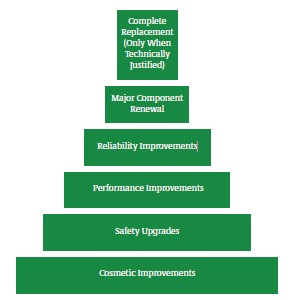
تحسينات التجميل
The first level addresses the visible condition of the installation. Although cosmetic improvements do not directly affect operational performance, they significantly influence passenger perception and the overall image of the facility.
Modernization should progress from the least intrusive interventions to the most extensive. Each level should be fully evaluated before moving to the next. Complete replacement therefore becomes the final engineering option rather than the default starting point.
وتشمل التدابير النموذجية ما يلي:
- Replacement of damaged skirt panels
- Balustrade refurbishment
- Stainless-steel polishing
- Step cleaning or selective step replacement
- ترقيات الإضاءة LED
- Decking refurbishment
- Replacement of worn comb plates and floor plates
These relatively low-cost improvements can substantially enhance the appearance of an aging escalator while extending the period before more extensive interventions become necessary.
ترقيات السلامة
Passenger safety remains the highest priority throughout the service life of an escalator.
As safety standards continue to evolve, many existing installations can benefit from targeted upgrades recommended by EN 115-2 without requiring complete replacement.
تشمل التحسينات النموذجية ما يلي:
- Upgrading safety monitoring devices
- Modern brake monitoring systems
- Handrail speed monitoring
- Improved emergency stop protection
- Missing step detection
- Enhanced combplate safety devices
- Integration with fire alarm and emergency management systems
Where practical, modernization should aim to achieve the highest reasonably attainable level of safety while retaining structurally sound equipment.
تحسينات في الأداء
Performance improvements focus on enhancing operational efficiency, passenger comfort and energy performance.
Typical modernization measures include:
- Replacement of relay-/PLC-based controllers with microprocessor-based control systems
- Installation of VFDs
- Improved acceleration and deceleration characteristics
- Energy-saving operating modes
- Reduced vibration and operational noise
- Enhanced fault diagnostics and monitoring
For consulting engineers and modernization specialists, the challenge is to determine whether complete replacement is technically justified or whether a carefully planned modernization program can restore safety, improve reliability, extend operational life and deliver greater long-term value.
These upgrades often produce noticeable improvements in ride quality while reducing maintenance requirements and operating costs.
تحسينات الموثوقية
Recurring breakdowns are frequently associated with a relatively small number of aging mechanical or electrical components rather than deterioration of the entire escalator.
Engineering assessment should identify components exhibiting excessive wear, reduced reliability or limited spare-part availability.
Typical reliability improvements include:
- Renewal of drive chains
- Replacement of bearings and sprockets
- Brake refurbishment
- Lubrication system upgrades
- Replacement of obsolete electrical components
- Wiring improvements
- Installation of modern diagnostic systems
Targeted replacement of these components often restores dependable operation while avoiding the cost and disruption associated with complete replacement.
Major Component Renewal
Only after lower levels of the pyramid have been evaluated should engineers consider the replacement of major assemblies.
تشمل الأمثلة النموذجية ما يلي:
- Complete controller replacement
- Drive machine replacement
- Step chain renewal
- Handrail replacement
- Brake assembly replacement
- Major electrical system renewal
Such interventions should always be supported by detailed engineering assessment demonstrating that the existing components have reached the end of their practical service life.
استبدال كامل
Complete replacement represents the highest level of intervention and should be recommended only when engineering evaluation demonstrates that modernization is no longer technically, economically or operationally viable.
Typical conditions supporting complete replacement include:
- Structural deterioration of the truss
- Extensive corrosion affecting structural integrity
- Inability to achieve acceptable safety levels through modernization
- Fundamental design limitations
- Obsolete equipment with no practical modernization pathway
- Life-cycle cost analysis demonstrating that replacement provides greater long-term value
Replacement should therefore be regarded as the outcome of a structured engineering assessment rather than an assumption based solely on equipment age.
أهمية الهندسة
The Escalator Modernization Decision Pyramid provides a systematic methodology for evaluating modernization options in a logical sequence. It encourages engineers to prioritize safety, reliability, operational performance and life-cycle value before recommending major capital expenditure.
By applying this framework, consultants, facility managers and building owners can make modernization decisions that are technically justified, economically responsible and aligned with internationally recognized engineering practices.
Engineering Decision Matrix for Escalator Modernization
Selecting the appropriate modernization strategy is one of the most significant decisions in the life cycle of an escalator. While complete replacement may be technically justified in some cases, many installations can continue to provide safe and reliable service through carefully planned modernization programs.
Before committing to major capital investment, building owners, consultants and facility managers should undertake a structured engineering evaluation that considers both the technical condition of the equipment and the operational requirements of the facility.
The following decision matrix provides a practical framework for evaluating whether modernization or complete replacement represents the most appropriate engineering solution.
مصفوفة قرارات الهندسة
- Is the structural truss suitable for continued service?
The structural truss is the foundation of the escalator and often has the longest service life. If detailed inspection confirms that it remains structurally sound and free from significant corrosion or deformation, modernization may provide a technically viable alternative to complete replacement.
- Which components have genuinely reached the end of their service life?
Escalator subsystems deteriorate at different rates. Controllers, drive systems, handrails, safety devices and electrical components frequently require renewal long before the primary structure. Decisions should therefore be based on engineering assessment rather than chronological age.
- Can the escalator achieve current safety expectations through modernization?
Modern safety improvements recommended under EN 115-2 can often be incorporated into existing installations without replacing the entire escalator. Upgrading monitoring systems, safety devices, brake supervision and emergency interfaces may significantly improve operational safety while preserving serviceable components.
- Does the proposed modernization support the operational requirements of the building?
Every building presents different operational challenges. Shopping malls, airports, hospitals, metro stations, hotels and commercial developments each have unique traffic patterns, service expectations and maintenance constraints. The modernization strategy should therefore reflect the operational function of the facility rather than follow a standard replacement approach.
- What additional service life can realistically be achieved?
A comprehensive engineering assessment should estimate the expected extension of service life following modernization. Where structurally sound equipment can continue to operate safely and reliably for many additional years, modernization may represent the more sustainable engineering solution.
- What operational disruption can be avoided?
Complete replacement often involves extensive dismantling, structural modifications, prolonged shutdowns and significant disruption to building operations. In occupied facilities, these indirect costs may exceed the savings achieved through a replacement-focused strategy.
Strategic modernization generally reduces project duration, minimizes disruption to tenants and building users and allows facilities to maintain normal operations wherever practical.
Decisions based solely on equipment age often result in unnecessary replacement of serviceable components, while overlooking systems that genuinely require renewal. A structured technical evaluation enables modernization strategies to be developed on the basis of actual equipment condition, operational requirements and life-cycle value.
The objective is not to replace the maximum number of components, but to restore safety, reliability and performance while preserving assets that continue to provide engineering value.
- Which option delivers the greatest life-cycle value?
Engineering decisions should consider the total life-cycle cost of ownership rather than initial capital expenditure alone. Factors such as maintenance costs, equipment reliability, energy performance, operational continuity, spare-part availability, future maintainability and expected service life should all form part of the investment evaluation.
The objective is not to identify the least expensive solution, but the solution that delivers the greatest long-term value while maintaining safety and operational performance.
خاتمة
As the global stock of ageing escalators continues to increase, modernization strategies will play an increasingly important role in asset management. The challenge facing the industry is no longer simply replacing aging equipment but determining the most appropriate engineering intervention based on technical evidence, operational requirements and life-cycle performance.
A structured engineering assessment — supported by the principles of EN 115-1, EN 115-2, manufacturer recommendations and applicable local regulations — provides a rational basis for these decisions. By evaluating each subsystem independently, engineers can distinguish between components requiring renewal and those that continue to provide reliable service.
Strategic partial modernization is not an alternative to engineering; it is the result of sound engineering. It enables owners to enhance safety, improve reliability, extend operational life, reduce project disruption and maximize the return on existing assets without unnecessary replacement.
Ultimately, the success of a modernization project should not be measured by the quantity of equipment replaced, but by the quality of the engineering decisions that preceded it. The most effective projects are those that replace only what is necessary, preserve what continues to perform and deliver the optimum balance between safety, performance, sustainability and long-term value.
مراجع حسابات
[1] EN 115-1:2017+A1:2021 – Safety of Escalators and Moving Walks – Part 1: Construction and Installation
[2] EN 115-2:2021 – Safety of Escalators and Moving Walks – Part 2: Rules for the Improvement of Safety of Existing Escalators and Moving Walks
[3] ISO 25745-3 – Energy Performance of Lifts, Escalators and Moving Walks – Part 3: Energy Calculation and Classification for Escalators and Moving Walks
[4] ASME A17.1/CSA B44 – Safety Code for Elevators and Escalators
[5] Manufacturer modernization manuals and technical documentation
أبرز المهنية
30-plus years in the VT industry
2,000-plus elevator, escalator and automated parking systems delivered
Specialist in elevator modernization and high-rise installation
Executive MBA | Diploma in Electrical Engineering
Author, innovator and technical contributor
Extensive leadership experience across the GCC (global capacity center)
المزيد من الفئة
أخبار يومية