
Dispositivos de travamento de portas
By João W. Koshak | Educação continuada | 31 de julho de 2026
Tempo de leitura: 17 minutos
OUÇA ESTE ARTIGO
Door locking devices are mandated by ASME A17.1/CSA B44 to prevent deadly falls, with only two types allowed in Part 2: interlocks and mechanical lock with closed detection means. Listing and labeling by NRTLs and type testing aim to ensure consistent manufacture and performance, and maintenance is required. Private residence elevator rules permit electrically released locking devices that may allow a car to start before the mechanical lock engages, enabling solenoids to unlock the wrong landing and causing fatal falls; courts have treated some designs as defective. Mitigation includes retiring cams, horizontally sliding doors, absolute position systems, independent landing switches, and redundant software checks. Existing PRE fleets must be inspected and corrected and Code committees and industry must act.
O autor explica esses conceitos em termos simples e define por que é fundamental que os funcionários de elevadores os examinem.
Por John W. Koshak
Objetivos de aprendizagem
Após ler este artigo, você deverá ter aprendido:
- There are only two types of Door Locking Devices in Part 2 of ASME A17.1/CSA B44.
- The PRE requirements in section 5.3 do not reference requirement 2.12 - Door Locking Devices. They renamed them “Locking Devices.”
- Electrically released locking devices can be unlocked in error, exposing a fall hazard.
- There are more than 200,000 PREs installed in the U.S. and Canada.
- They can be used, provided extra measures are taken.
- These devices have been ruled a defective product as a matter of law.
- What can be done to protect the public.
- Awareness of the issue is key to preventing future incidents.
What Are Door Locking Devices?
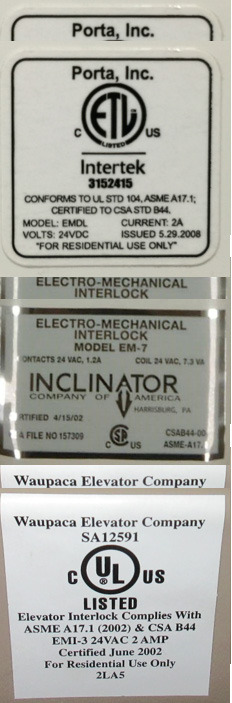
There are many types of elevators: Passenger, freight, mine, rooftop, elevators used for construction and private residence elevators (PREs) to name a few. They all share the same fall risk, a risk mitigated by requiring a Door Locking Device on each hoistway door. If the door is openable without the presence of the elevator car, a severe and deadly fall hazard exists. For this reason, dependability of the Door Locking Devices is ensured by requiring strict adherence to the prescriptive requirements of ASME A17.1/CSA B44 Code in the U.S. and Canada, then verification, by testing of the design by an independent test laboratory. This is known as “Listing” and “Labeling” the devices, the label being evidenced by their “Mark.” Examples are shown in Figure 1.Underwriters Laboratories (UL), Canadian Standards Association (CSA), Electrical Testing Laboratory (ETL) and Warnock Hersey (WH) are common in the U.S. and Canada. They are approved as “Nationally Recognized Testing Laboratories” (NRTLs) required by many Authorities Having Jurisdiction (AHJs).
All Door Locking Devices must be Labeled with specific information that identifies to which Code or Standard it was tested. By requiring Listing in the Code, manufacturers are required to manufacture them in precisely the same way to ensure the latest one off the assembly line is just like the tested one. Testing laboratories conduct surveillance of manufacturers by visiting the factory and verifying the drawings and product have not materially changed. They must have the same material properties, thickness, construction, assembly procedures and insulation resistance, all to ensure the performance will remain the same as the device they tested. If a manufacturer changes anything, they are required to contact their testing NRTL and notify them of the change. The NRTL will then approve the minor change or may require retesting if, in their judgment, the changes are significant. If the design is substantially different, the NRTL may withdraw their approval to Label. This would be devastating, as the manufacturer could no longer sell the product. It also brings into question the product’s compliance and manufacturer’s compliance posture.
The Code requires Listing and Labeling of several components, all for the same purpose: to assure the latest manufactured component is the same as the tested component. Labels are inspected by AHJs to ensure an unknown component has not slipped into the installation of the elevator or escalator to ensure public safety. All of these protections rely on the Code or Standard. If the prescriptive language allows an unsafe condition, the device may be listed and have the unsafe condition passed on into the marketplace. Code writers must be aware and knowledgeable when writing requirements.
Failure of a Door Locking Device can be fatal; the Code addresses this by requiring a “Type Testing” for Listing and Labeling the Door Locking Device in section 8.3, requirement 8.3.3. Further, the Code requires maintenance be performed on them in section 8.6, requirement 8.6.4.13. From manufacturing to modernization, the life of Door Locking Devices is monitored to assure they cannot fail. This article will explain them in common terms and why it is critical for elevator personnel to examine them, as required by the Maintenance Control Program (MCP). It will also explain how when some Door Locking Devices fail in their primary function, the results can be devastating. Finally, this article will offer lessons learned going forward and how to never allow this type of failure to occur.
Valor: 1 hora de contato (0.1 CEU)

This article is approved for Continuing Education by NAEC for CET, CAT and QEI and NAESA for QEI.
A EW Continuing Education está atualmente aprovada nos seguintes estados: AL, AR, CO, FL, GA, IL, IN, KY, MD, MO, MS, MT, NJ, OK, PA, UT, VA, VT, WA, WI e WV | Províncias canadenses de BC e ON. Verifique a aprovação de cursos específicos em [link para o site da EW]. elevatorbooks.com.
What Does the Code Say?
ASME A17.1/CSA B44, section 2.12 prescribes the function of Door Locking Devices and the only two types permitted: the Interlock and the Mechanical Lock and Closed-Door Detection Means (formally Mechanical Lock and Electric Contact).
ASME A17.1-2025/CSA B44:25
SEÇÃO 2.12
Hoistway Door Locking Devices and Closed Detection Means, and Hoistway Access Switches
2.12.1 Geral for passenger elevators, the unlocking zone from the landing floor level shall be not less than 75 mm (3 in.) nor more than 175 mm (7 in.). For freight elevators with vertically sliding doors, the unlocking zone from the landing floor level shall be not less than 75 mm (3 in.) nor more than 450 mm (18 in.).
2.12.1.1 When the car is stopped within the unlocking zone, the hoistway doors shall be unlocked, or locked but openable from the landing side either manually or by power.
2.12.1.2 When the car is outside the unlocking zone, the hoistway doors shall be openable from the landing side only by a hoistway door unlocking device (see 2.12.6, 2.12.7, and Nonmandatory Appendix B).
2.12.1.3 For security purposes, hoistway doors shall be permitted to be locked out of service, subject to the requirements of 2.11.6.
2.12.1.4 Passenger elevator hoistway doors shall be equipped with interlocks conforming to 2.12.2. ...
2.12.2 Intertravamentos
2.12.2.3 Operation of the Driving Machine With a Hoistway Door Unlocked or Not in the Closed Position.
Operation of the driving machine when a hoistway door is unlocked or not in the closed position (see 2.12.2.2) shall be permitted under one of the following conditions:
- (a) by a car-leveling or truck-zoning device (see 2.26.1.6)
- (b) when a hoistway access switch is operated (see 2.12.7)
- (c) when a bypass switch is activated (see 2.26.1.5) ...
A17.1-B44, section 2.12.4 prescribes the label requirements after compliance with requirement 8.3.3 are verified.
2.12.4 Listing/Certification of Door Locking Devices and Door or Gate Closed Detection Means
2.12.4.1 Type Tests.
Each type and make of hoistway door interlock, car door interlock, hoistway door combination mechanical lock and closed detection means, and door or gate closed detection means shall conform to the type tests specified in 8.3.3, unless tested prior to:
- (a) August 1, 1996, and shall have been subjected to the tests specified in ASME A17.1a-1994, Section 1101
- (b) March 23, 2002, in jurisdictions enforcing CSA B44, and shall have been subjected to the tests specified in CSA B44S1-97, Clause 11.5
The tests shall be done by or under the supervision of a certifying organization.
2.12.4.2 Listing/Certification.
Each type and make of hoistway door interlock, car door interlock, hoistway door combination mechanical lock and closed detection means, and door or gate closed detection means shall conform to the general requirements for tests and certification specified in 8.3.1.
In 2019, the Code changed the term "Electric Contacts" to "Closed Detection Means" wherever "Electric Contacts" were referenced in the Code. This change only applies to the Door Locking Device electric contacts, not the design requirements of the device overall. This is an example of ASME requiring the A17 Committees to change the format from "prescriptive" requirement language drafting to "performance" requirement language. Prescriptive requirements define the design requirements of a component that performs a function. Performance requirements define the required function and give designers the freedom to design anything to meet the performance requirement.
Intertravamentos
Rules for interlock design and function have been around since the first Code in 1921. In 1955, PREs were just entering the A17.1 Code, which tried to change what an interlock is because PREs wanted to eliminate stationary cams and interlock pick-up rollers. These made a noise as the elevator passed each landing. Commercial elevators have vanes and clutches that noiselessly pass landings because the demand to open the door was provided by the horizontal motion of the car door. When the car is at a landing, a clutch or vane engages a pickup roller assembly and the captured hoistway door is mechanically slaved to the car door until fully closed again.
Residential elevator designers had a design choice to make: use a powered retiring cam so the car could pass interlock pick up roller assemblies without any physical contact or use an electric solenoid to unlock the Door Locking Device. Interlocks prohibit the closed electric contact from closing until after the hoistway door is mechanically locked, therefore prohibiting the car from restarting unless the door is mechanically locked. The use of solenoid Door Locking Devices allows car movement prior to mechanically locking the hoistway door, making closed and locked two separate actions.
Code writers in 1955 knew the potential for unlocking the wrong door at a landing without an elevator present using a solenoid was a foreseeable risk. They warned that these devices were not interlocks in Rule 111.3b(3) (emphasis added):
Norma ASME A17.1-1955
SECTION 111-Hoistway-Door Locking Devices, Car-Door or Gate Electric Contacts, Hoistway Access Switches, and Elevator Parking Devices
Rule 111.1 Locking Devices Required
111.1a For Power Passenger Elevators. Hoistway doors shall be equipped with hoistway-unit system hoistway-door interlocks.
Rule 111.3 Hoistway-Door Interlocks and Operating Cams
111.3a Operation of the Driving Machine with a Hoistway Door Unlocked or not in the Closed Position.
Operation of the driving machine when a hoistway door is unlocked or not in the closed position (see Rule 111.8) is permissible under the following conditions:
1 By a car-leveling or truck-zoning device (see Part II, Section 210, Rule 210.1e).
2 By a combination hoistway access switch and operating device (see Rule 111.10).
3 When a hoistway access switch is operated (see Rule 111.10).
111.3b General Design Requirements. Interlocks shall conform to the following requirements:
1 Interlock contacts shall be positively opened by the locking member or by a member connected to and mechanically operated by-the locking member, and the contacts shall be maintained in the open position by the action of gravity or by a restrained compression spring, or by both, or by means of the opening member.
2 The interlock shall hold the door in the locked position by means of gravity or by a restrained compression spring, or by both, or by means of a positive linkage.
3 The interlock shall lock the door in the closed position before the driving machine can be operated by the normal operating device.
EXCEPTION: As provided in Rule 111.3a.
Devices which permit operation of the driving machine by the normal operating device when the door is closed but before it is locked, are not interlocks and are not permitted where interlocks are required by this code.
This warning exists even today in the 2025 edition (emphasis added):
ASME A17.1-2025/CSA B44:25
SECTION 2.12 Hoistway Door Locking Devices and Closed Detection Means, and Hoistway Access Switches
Geral 2.12.1
For passenger elevators, the unlocking zone from the landing floor level shall be not less than 75 mm (3 in.) nor more than 175 mm (7 in.). For freight elevators with vertically sliding doors, the unlocking zone from the landing floor level shall be not less than 75 mm (3 in.) nor more than 450 mm (18 in.). ...
2.12.2 Intertravamentos
2.12.2.1 General. Each entrance at a landing to an elevator used for passengers or freight and not conforming to 2.12.3.1 shall be equipped with one or more interlocks meeting the design requirements of 2.12.2.4. ...
2.12.2.4.5 The interlock shall lock the door in the closed position with a minimum engagement of 7 mm (0.28 in.) of the locking members before the interlock detection means detects the closed and locked position and before the driving machine can be operated, except as permitted in 2.12.2.3.
Devices that permit operation of the driving machine by the normal operating device when the door is closed but before it is locked are not interlocks and are not permitted where interlocks are required by this Code.
The key language is, despite being a passenger elevator, the PRE Committee wrote their own exception to the Code in what is today requirement 5.3.1.8.4, allowing the elevator start even if the hoistway door is closed but still not mechanically locked. The ramifications of this allowance has resulted in multiple injuries and fatalities in the PRE sector of the industry when the solenoid coil is energized in error — when the car is at a different landing. One court ruled that "Locking Devices" using a solenoid coil to unlock in this manner is a product defect. If the sole purpose of the locking device is to keep the hoistway door locked unless there is an elevator at the landing, if it unlocks without an elevator present, it has failed its only design function. If the locking device has not been modified and is the same as it was when it was manufactured and installed, and the device was used as intended and actual harm occurred — it is a defective design.
How are solenoid locking devices allowed? The prohibition of requirement 2.12.2.4.5 is to not call them "interlocks" in the Code. There was not a prohibition to using them at all since the Code in section 5.3 allows them, and therefore, short of not calling them interlocks, they are permitted in another section of the Code, namely section 5.3. The PRE Committee writes their own requirements which allows their design and use, and therefore "in the Code and an interlock is not required" (emphasis added):
ASME A17.1-2025/CSA B44:25
SEÇÃO 5.3
Elevadores para residências privadas
5.3.1.8.4 Locking Devices for Hoistway Doors and Gates. Hoistway doors or gates shall be provided with locking devices.
The locking device shall be a type that will either
(a) prevent car movement unless the door is locked in the closed position
(B) permit the car to start if the door or gate is in the closed position but not locked, provided that the device stops the car if the door or gate fails to lock before the car has moved 150 mm (6 in.) away from the landing.
The device shall also prevent the opening of the hoistway door or gate unless the car is within 150 mm (6 in.) of the landing.
The locking device shall conform to 2.12.4.
The last sentence of requirement 5.3.1.8.4 is significant because requirement 2.12.4 are the Type Test requirements (emphasis added):
2.12.4 Listing/Certification of Door Locking Devices and Door or Gate Closed Detection Means
2.12.4.1 Testes de tipo. Each type and make of hoistway door interlock, car door interlock, hoistway door combination mechanical lock and closed detection means, and door or gate closed detection means shall conform to the type tests specified in 8.3.3, unless tested prior to
(a) August 1, 1996, and shall have been subjected to the tests specified in ASME A17.1a-1994, Section 1101
(b) March 23, 2002, in jurisdictions enforcing CSA B44, and shall have been subjected to the tests specified in CSA B44S1-97, Clause 11.5
The tests shall be done by or under the supervision of a certifying organization.
2.12.4.2 Listing/Certification. Each type and make of hoistway door interlock, car door interlock, hoistway door combination mechanical lock and closed detection means, and door or gate closed detection means shall conform to the general requirements for tests and certification specified in 8.3.1.
These type tests do not list “Locking Devices” in requirement 5.3.1.8.4. Requirement 8.3.3 applies to interlocks, combination mechanical locks and electric contacts and door or gate electric contacts.
8.3.3 Type Tests of Interlocks, Combination Mechanical Locks and Electric Contacts, and Door or Gate Electric Contacts
Geral 8.3.3.1. Paragraph 8.3.3 specifies the type tests of hoistway door interlocks, car door interlocks, combination mechanical locks and closed detection means and hoistway door and car door or gate closed detection means.
Labeling Residential Locking Devices
Despite requirement 2.12.2.4.5 language specifying “Locking Devices” cannot be called an “interlock,” some residential locking device manufacturers label them as “Interlocks” complying with A17.1 as seen in Figure 2. They are not interlocks according to requirement 5.3.1.8.4; they do not have to prevent the car from starting until the lock is closed and locked — just closed only and the lock is not required to be closed for up to 150 mm (6 in.). The PRE Committees’ choice of the term “Locking Device” in their heading indicates they were clearly aware that the locking device is not an interlock and still require a type test in requirement 5.3.1.8.4.
The requirements in 8.3.3 relate to specific device prescriptions and failures specific to the requirements. For example, the residential locking device must be cycled 45,000 cycles, then subjected to salty humid air and other varied tests. Interlocks are subjected to 985,000 cycles, then the various other tests. Operational control of the locking device has no requirements for absolute position of the elevator car. With decades of failures, changing the requirements to ensure safety has not yet been added to the Code.
Like writing all Code requirements, writing allowances and exceptions makes some presumptions, like the device will always function correctly. Unless a risk assessment is performed to consider possible and actual failures, and mitigations required and codified for the foreseeable and actual risks, many risks can be overlooked — even if the device is labeled. The design and use of devices are dependent on the thoroughness of the Committees’ review of these risks. In this case, unlocking the locking device when the elevator is at the wrong landing does not violate the label; it is a defective lack of mitigating the location of the elevator relative to the electrical unlocking of a landing floor.
Safely Using Locking Devices
How can “locking devices” be used safely? The mitigation to this deadly hazard is to absolutely know the elevator is at the landing where the locking device solenoid coil is located. All passenger elevators with horizontally sliding doors have this feature because the car door mechanically couples with the hoistway door when the vane or clutch actuates the pickup assembly. PREs rarely use horizontally sliding doors. The vast majority use swing doors; therefore, this type of passenger elevator should be provided with a retiring cam that drops onto an interlock pick up assembly or utilizes horizontally sliding doors or adds an absolute position system or adds independent landing switches to open the solenoid coil circuit to prevent unlocking if the controller believes the car is at one landing but is actually at another landing or utilizes an absolute positioning system with compliant electrical requirements of requirements 2.26.9.3 and 2.26.9.4 for software redundancy and checking.
Despite proposed changes submitted to the PRE Committee, these devices continue to be utilized and worse yet, hundreds of thousands of installed elevators have these vulnerabilities. After investigating many falls into the hoistway due to energizing the incorrect locking device, these incidents continue to occur. It is a risk that must be corrected on the installed fleet of elevators to prevent future incidents.
Conclusão
Section 5.3 allows locking devices to unlock with electricity, energizing a solenoid coil to lift a mechanical locking member. This function is separate from the requirement that the electric contact not be allowed to close until the mechanical lock is in the locked position. To prevent these incidents from occurring, there must be an examination of the existing installed equipment and these known failures mitigated. Future designs must provide a means to ensure the use of these devices cannot electrically unlock unless the elevator car is actually at the correct landing.
This is a critical issue that should be addressed by the PRE Committee and all installers and maintainers of PREs.
Referência
[1] The reference in the title “Mechanical Lock and Electric Contacts” was not changed as noted above.
Perguntas de reforço de aprendizagem
Utilize as questões de reforço de aprendizagem abaixo para estudar para o Exame de Avaliação de Educação Continuada, disponível online em
elevatorbooks.com ou na página 136 desta edição.
- What are the two types of Door Locking Devices allowed in Part 2 of the ASME 17.1/CSA B44?
- How many PREs are installed in the U.S. and Canada?
- What are the maintenance procedures necessary to ensure correct operation of the locking devices?
- What can be done to protect the public?
- What can be done as an installer to eliminate the risk of unlocking a hoistway door if the elevator car is not at that landing?

MAIS DA CATEGORIA
NOTÍCIAS DIÁRIAS