
Yapay Zeka, Nesnelerin İnterneti ve BIM Entegrasyonu ile Geleceğin Akıllı Asansör Sistemleri
By Volkan Murat | ♦ Dijitalleşme: | 13 Temmuz 2026
Okuma süresi 8 dakika
BU MAKALEİ DİNLEYİN
Digital transformation is turning elevators into data-driven systems where AI, IoT and BIM enable continuous sensor monitoring, predictive maintenance and digital twins. Real-time motor, brake, door and vibration data let machine learning detect anomalies, optimize maintenance timing and cut costs, yielding about $31,290 annual net savings for a 14-elevator portfolio alongside 40% fewer breakdown costs, 60% less downtime and a 15% workforce optimization. AI also enables personalized calls and traffic optimization, while regenerative drives and AI energy management can lower consumption 20 to 40 percent. BIM-integrated digital twins improve lifecycle management and safety by enabling faster diagnostics and automated emergency workflows, transforming elevators into active building decision-support assets.
submitted by Volkan Murat ORAKCI, R&D Engineerof Merih Elevator
1. Giriş
For many years, elevator technologies have focused on the development of mechanical and electromechanical systems. However, the digital transformation of the past decade has begun to significantly shift the industry’s priorities, and today, the performance of an elevator system cannot be evaluated solely based on criteria such as carrying capacity, speed or comfort. Operating costs, energy efficiency, maintenance process management and user experience are now considered just as important as technical performance.
From the perspective of engineers working in the field, it is well known that unplanned downtime is one of the most significant problems encountered throughout the life cycle of an elevator.
Unexpected breakdowns, particularly in heavily used commercial buildings, not only increase maintenance costs but also directly impact building operations. For this reason, the industry has shifted its focus in recent years from reactive approaches to addressing breakdowns to solutions aimed at predicting them in advance.
Artificial intelligence (AI), the Internet of Things (IoT), and Building Information Modeling (BIM) technologies have become key components of this much-needed transformation. Thanks to advancements in sensor technology, in particular, it is now possible to continuously collect data from elevator systems; this data can be analyzed to derive meaningful insights into equipment behavior.
This study examines the contributions these technologies can make to elevator systems, current applications and potential future opportunities from an engineering perspective.
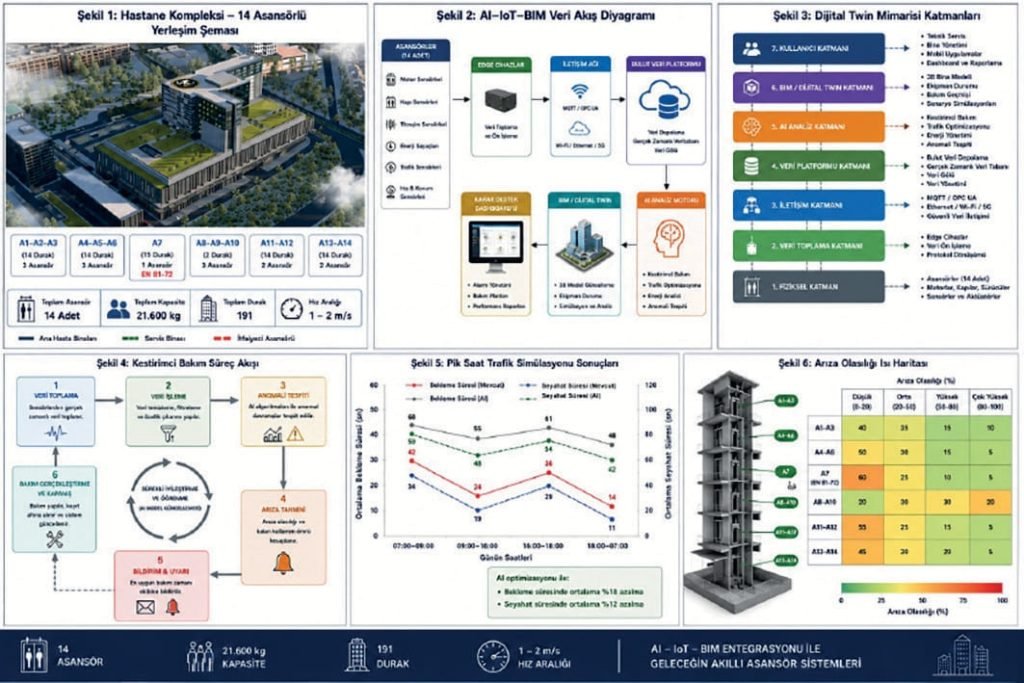
| Asansör Grubu | Parça | Standart | Shaft Steel Construction | Shaft Measurement (mm) | MR/MRL | Hız m/s | Durak Sayısı | Kapasite (kg) |
| A1-A2-A3 | 3 | EN 81-20/50 | Evet | 7400 × 3600 | MR | 2.0 | 14 | 1600 |
| A4-A5-A6 | 3 | EN 81-20/50 | Evet | 7400 × 3600 | MR | 2.0 | 14 | 1600 |
| A7 | 1 | EN-81 72 | Yok hayır | 3200 × 3500 | MR | 2.0 | 15 | 1600 |
| A8-A9-A10 | 3 | EN 81-20/50 | Evet | 7400 × 3600 | MR | 1.0 | 2 | 1600 |
| A11-A12 | 2 | EN 81-20/50 | Evet | 4800 × 2900 | MR | 2.0 | 14 | 1600 |
| A13-A14 | 2 | EN 81-20/50 | Evet | 4800 × 2900 | MR | 2.0 | 14 | 1600 |
1. Annual Maintenance Cost Analysis
varsayımlar
· Total number of elevators: 14
· Average annual maintenance cost (traditional system): US$6,500/ elevator
· Additional cost due to breakdowns: US$1,800/elevator/year
· Cost of unplanned downtime: US$900/elevator/year
After AI-Supported Predictive Maintenance
Beklenen İyileştirmeler
· 40% reduction in breakdown costs
· 60% reduction in downtime
· 15% optimization of maintenance workforce
Eşya maliyeti Yıllık Toplam (USD)
Scheduled maintenance contract US$77,350
Failure repair costs US$15,120
Operational loss due to downtime US$5,040
Toplam 97,510 ABD Doları
Yıllık Tasarruf
· Traditional system: US$128,800
· AI-supported system: US$97,510
· Annual net savings: US$31,290
| Traditional Maintenance Costs | Eşya maliyeti | Birim Maliyet (USD) | Adet | Yıllık Toplam (USD) |
| Scheduled maintenance contract | 6500 | 14 | 91.000 | |
| Breakdown repair costs | 1800 | 14 | 25.200 | |
| Operational loss due to downtime | 900 | 14 | 12.600 | |
| Toplam | 128.800 |
2. IoT-Based Smart Elevator Architecture
The foundation of smart elevator systems is an IoT infrastructure.
Data collected from motors, drives, brake systems, door mechanisms and safety equipment can be transmitted to central data platforms.
Bu sistemlerde,
• Motor temperature,
• Brake cycle count,
• Door opening/closing frequency,
• Vibration levels,
• Energy consumption,
• Passenger density,
• Air quality can be continuously monitored.
Thanks to real-time data collection, equipment performance is continuously evaluated, making it possible to detect faults before they occur.
3. Yapay Zeka Destekli Tahmini Bakım
In traditional maintenance approaches, maintenance activities are performed at fixed intervals. However, since the actual operating conditions of the equipment are not taken into account, this can lead to unnecessary part replacements or unexpected failures.
AI-based predictive maintenance systems:
- Analyze sensor data,
- Detect abnormal behavior,
- Calculate failure probabilities,
- Optimize maintenance timing.
For example, minor deviations in a door operator's closing time or changes in motor vibration can be evaluated by machine learning algorithms to identify potential failure scenarios in advance. This approach reduces maintenance costs while increasing system availability.
4. Personalization of the User Experience
AI-powered systems can learn user habits to provide a more efficient service.
Gelecekte:
- Automatic elevator call generation as the user approaches the building,
- Integrated operation between the parking lot and the elevator,
- Display of daily weather forecasts and building announcements on cabin screens,
- Traffic optimization by algorithms that learn floor preferences will be possible.
Such applications can significantly reduce wait times, particularly in high-density mixed-use buildings.
5. Energy Management and Regenerative Systems
Energy efficiency in elevators has become one of the key areas of research in recent years. Thanks to regenerative drive systems, excess energy generated during the cabin's movement can be fed back into the grid. AI algorithms analyze this energy flow to:
- Identify energy consumption trends
- Predict peak loads
- Develop energy optimization strategies
Research shows that regenerative drive technologies can reduce energy consumption by 20–40% under appropriate operating conditions.
6. BIM Integration and the Digital Twin Approach
BIM technology enables the management of a building's life cycle in a digital environment. The integration of real-time data from elevator systems with the BIM model gives rise to digital twin applications. Thanks to this approach:
- Equipment status can be monitored via a 3D model
- Maintenance history can be viewed
- Failure scenarios can be simulated
- Life-cycle costs can be analyzed
Digital twin technologies provide significant advantages in building management processes.
7. Safety and Emergency Management
AI-supported systems offer significant opportunities not only for maintenance and energy efficiency but also in terms of safety. In particular:
- Rapid analysis of situations where passengers are trapped inside the elevator car
- Automatic initiation of rescue procedures
- Uzaktan teşhis
- And pre-notifying service teams
Such applications can reduce response times. However, final safety decisions must be made by qualified technical personnel in accordance with relevant standards.
8. Sonuç
With the integration of AI, IoT and BIM technologies, elevator systems are evolving into data-driven and predictable structures. Predictive maintenance, energy optimization, improvements in user experience and digital twin applications will play a significant role in the smart buildings of the future. In the near future, elevators are expected to become not just transportation equipment, but active data generators and decision-support systems within the building ecosystem.
Referanslar
Al-Sharif, L. (2017). Lift and Escalator Energy Consumption and Conservation. Wiley.
Bortolini, R., Forcada, N., Macarulla, M., & Casals, M. (2021). IoT and Artificial Intelligence Applications in Building Operations and Maintenance. Journal of Building Engineering, 44.
ISO 8100-32:2020. Lifts for the Transport of Persons and Goods — Planning and Selection of Passenger Lifts to be Installed in Office, Hotel, and Residential Buildings.
Peters Research Ltd. (2022). The Future of Elevator Traffic Management Systems.
KATEGORİDEN DAHA FAZLASI
GÜNLÜK HABERLER