
“Una nazione, un codice”
By Abhijit Dandekar | Codici e standard | Luglio 31, 2026
5 minuti di lettura
ASCOLTA QUESTO ARTICOLO
India is moving toward a unified lift and escalator code with IS 17900 Parts 1 and 2, published in December 2022 as modified adoptions of ISO 8100-1/2 to suit Indian conditions, with a three year transition so the new standard applies to shipments from December 2025. Bureau of Indian Standards aims for One Nation, One Code to harmonize rules nationwide, secure mutual recognition with international labs, align with regional standards, mandate qualification and certification of safety components, enforce licensing, and define annual recertification for full compliance. Adoption remains uneven across states, and additional 17900 parts for home lifts and seismic conditions plus related IS standards will be rolled out.
L'India si sta orientando verso una nuova normativa per ascensori e scale mobili.
by Abhijit Dandekar
Introduzione
The Indian government has been moving in the direction of “One Nation, One Code.” Two main new Indian Standards (IS) on Lifts for Transport of Persons and Goods were published in December 2022:
1) IS 17900 (Part 1): Safety Rules
2) IS 17900 (Part 2): Design Rules, Calculations, Examinations and Tests of Lift Components
These standards are modified adoptions of the International Organization for Standardization (ISO) 8100-1 and 2 (2019). IS 17900 (Part 1) is the main Prescriptive Standard, and it combines traction, hydraulic and machine-room-less lifts; IS 17900 (Part 2) defines design rules and calculations. A simultaneous running period of three years was publicized by the Bureau of Indian Standards (BIS) via a gazette notification. That means the new IS applies for all shipments from December 2025 onwards.
International Current Status
The main aim of revising the existing IS on lifts is to bring them to a level with international standards. Changes have been made in IS 17900-1:2022 from the ISO 8100-1:2019 for Indian market conditions.
ISO is a worldwide federation of national standards bodies (ISO member bodies). BIS is a founding member of ISO. ISO TC178 has an objective to harmonize lift standards across the world. As BIS and its associated Ministry is striving for “One Nation, One code,” ISO TC178 is striving for “one standard across the globe” for various sectors including lifts, escalators and moving walks. The 2026 plan for ISO is shown graphically in Figure 1.
The main aim of revising the existing IS on lifts is to bring them to a level with international standards. Changes have been made in IS 17900-1:2022 from the ISO 8100-1:2019 for Indian market conditions.
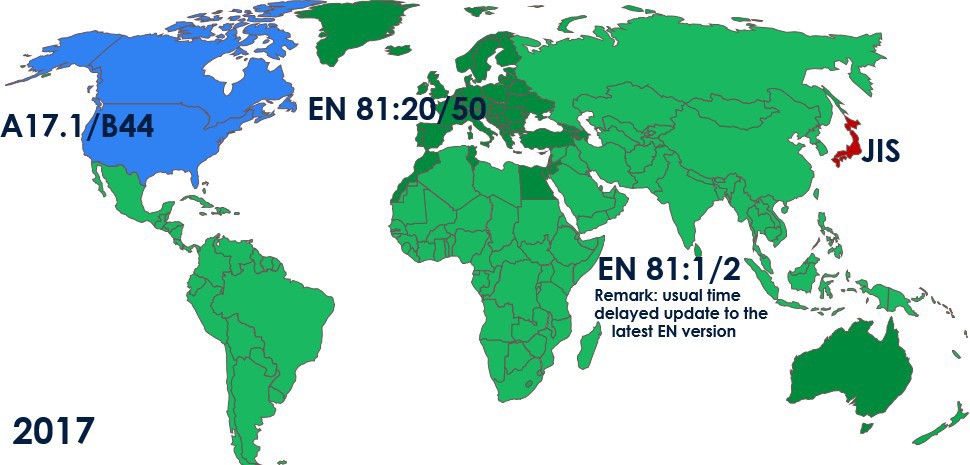
Current ISO Adoption Status Within Asia Pacific and China Region
| sr # | Paese | Standard Publication | ISO Adoption Status |
| 1 | India | IS 17900-1/2:2022 | Modified Adoption |
| 2 | Hong Kong | HK COP 2021 | Modified Adoption |
| 3 | Taiwan Cina | CNS15827-20 | Direct Adoption |
| 4 | Corea del Sud | KC2050 | Cite EN81-20&50 |
| 5 | Malaysia | MS EN 81-20/50 | Direct Adoption |
| 6 | Indonesia | Permanaker 6 2017 | Will adopt EN81-20/50 soon |
| 7 | Philippines | No National Code | All international codes |
| 8 | Singapore | SS550:2020+A1:2022 | Modified Adoption |
| 9 | Tailandia | No National Code | All international codes |
| 10 | Giappone | JISA4307-1&2 | Modified Adoption |
| 11 | Australia | AS1735.1 | Modified Adoption |
| 12 | Nuova Zelanda | BS EN81-20&50 | Modified Adoption |
| 13 | Vietnam | TCVN6395-20&50 | Direct Adoption |
| 14 | Cambogia | No National Code | All international codes |
| 15 | Cina | GB/T7588.1&2:2020 | Modified Adoption |
Current Indian Lift and Escalator Regulations Status
Out of 29 states and union territories in India, only 14 states have lift acts and rules. Some states, for example, Maharashtra, Gujarat, Assam, Himachal Pradesh, Delhi National Capital Region and West Bengal, have their own lift and escalator rules; Indian standards are used as guidelines only. Indian standards are now mandatory to be followed in seven states of India: Karnataka, Kerala, Tamil Nadu, Andhra Pradesh, Haryana, Jharkhand and Uttar Pradesh. Bihar is on its way to adoption.
“One Nation, One Code” Will Meet The Following Objectives In India:
- One elevator, escalator and moving walks standard across India
- One certification across India with mutual recognition agreements with international laboratories
- Alignment with an internationally accepted standard like ISO 8100-1/2, so there will be one standard across India, Asia Pacific and China
- Qualification and certification mandatory for all safety components specified under IS 17900-2:2022
- Enforcement of these laws, along with licensing requirements for all units across India
- Annual recertification process to be defined for 100% compliance
Standards That Can Be Made Applicable Across India Under “One Nation, One Code”
Other 17900 series standards, IS 17900 (Part 7/Section 3) on Lifts in Private Residences (Home Lifts) and IS 17900 (Part 7/Section 7) on Lifts under Seismic Conditions, will be published soon.
IS, not in 17900 series but connected with lifts and escalators, can also be the part of enforcement across India:
1) IS 17106 (PESSRAL and PESSRAE)
2) IS 17515 (Energy Efficiency)
3) IS 17518-2 (Fire-Resistance Tests for Lift Landing Foors)
4) IS 17615 (Ride Quality)
5) IS 17805 (EMC Guidelines)
6) IS 17806 (Guide Rails)
7) IS 2365 (Wire Ropes)
8) IS 4591 (Escalators and Moving Walks)
9) National Building Construction Standard 2026 (NBCS Vol 2/Part D/Section 5A, 5B and 5C).
Negazione di responsabilità: This article has been prepared in good faith with the objective of educating readers and increasing awareness of the standards applicable to lifts, escalators and moving walks across Asia, including China. The information presented is intended to provide a high-level overview and does not comprehensively address all applicable requirements, technical details or conditions. Readers are therefore advised to consult the original and official standards for complete and authoritative guidance. The views expressed in this article are solely those of the author and do not necessarily reflect the views of the author’s employer or any affiliated organization. Neither the author, the publisher, nor any associated organization shall be held liable for any actions taken or decisions made based on the information contained herein.
ALTRO DALLA CATEGORIA
NOTIZIE DEL GIORNO