
ESCO Elevators, Inc., Conclusión
By Dra. Lee Grey | Nuestra historia El | Julio 31, 2026
10 minuto de lectura
By the 1960s ESCO, led by Robert F. Loughridge, produced a broad line of oil-hydraulic passenger and freight elevators including freight units, Levelift platforms, dumbwaiters and specialty hospital, personnel and residential cars. The company claimed 18 industry firsts and secured patents for improved control and bypass valves that delivered smoother acceleration, accurate leveling and load-independent up-leveling. ESCO evolved through the 1970s and 1980s with larger capacities, holeless hydraulic designs and a new plant, yet Loughridge’s 1987 stroke exposed the absence of succession planning. Successive owners failed to reverse declining sales, and after bankruptcies in 1995 and 1997 ESCO ceased operations in 1998, underscoring the need for business continuity.
Las innovaciones en sistemas y productos continuarán hasta el capítulo final de la empresa.
por el Dr. Lee Gray, corresponsal de EW
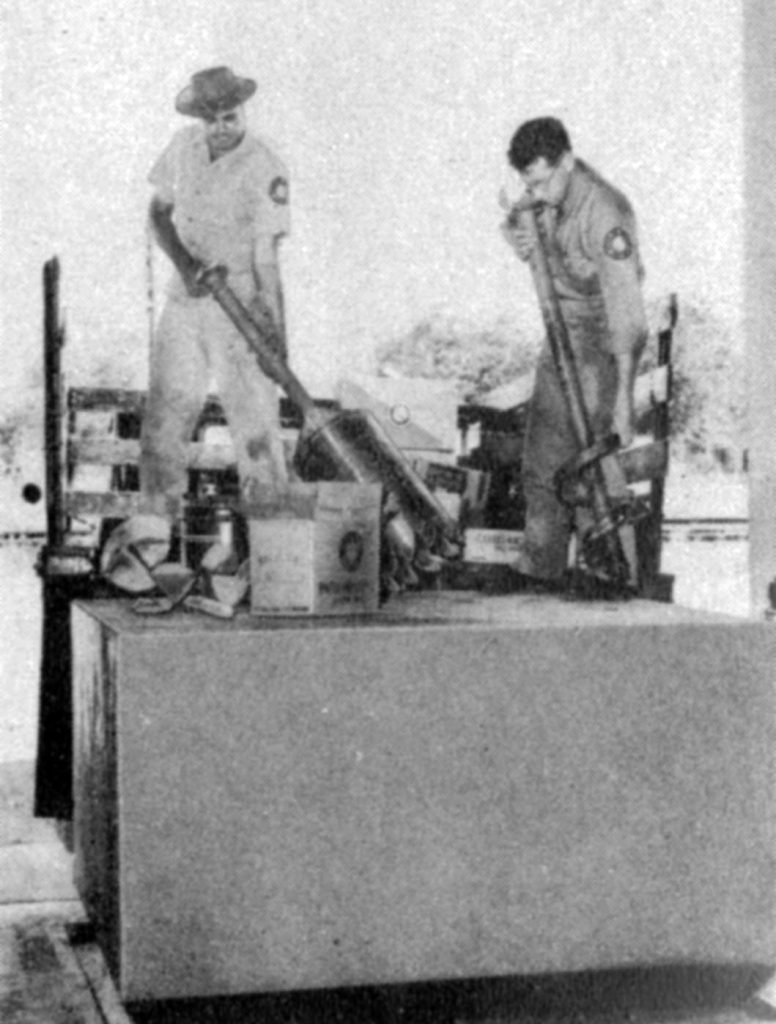
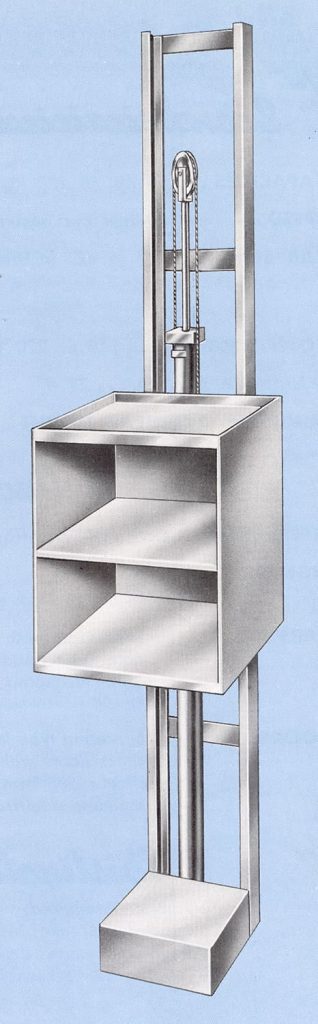
By the 1960s, ESCO founder Robert F. (Bob) Loughridge had established a company that manufactured a wide range of hydraulic elevators, which were produced under two broad categories: passenger and freight systems. ESCO’s standard freight elevator had a 20,000-lb capacity, an operating speed of 150 ft/min and a height limit of 55 ft (Figure 1). It featured a “fully automatic, accurate and dependable” floor-leveling system, and its operating systems included “selective collective, cumulative (collective control), single automatic and constant pressure push button.”[ 1 ] They also manufactured oil-hydraulic sidewalk freight elevators, which were described as “a great improvement over the old drum type. The capacity can be far greater if required, and when desired, platform can be arranged to travel above the sidewalk to truck bed height.”[ 1 ] ESCO also manufactured a system marketed as the Levelift, which was designed: “For buildings with no loading docks or where plant is on two or more levels. The ESCO Levelift facilitates loading and unloading freight from trucks or between two floor levels where rise is short.”[ 1 ] The Levelift had a capacity of 4000 lb and employed a simple open platform with no guardrails (the standard platform size was 6 ft x 8 ft) (Figure 2). A final product that could be included in this group was their hydraulic dumbwaiter, which had a capacity of 25 to 200 lb, a speed of 50 ft/min and a maximum travel distance of 22 ft. The car could be called for and sent from each landing, and the system featured "in-use" and "door open" lights (Figure 3).
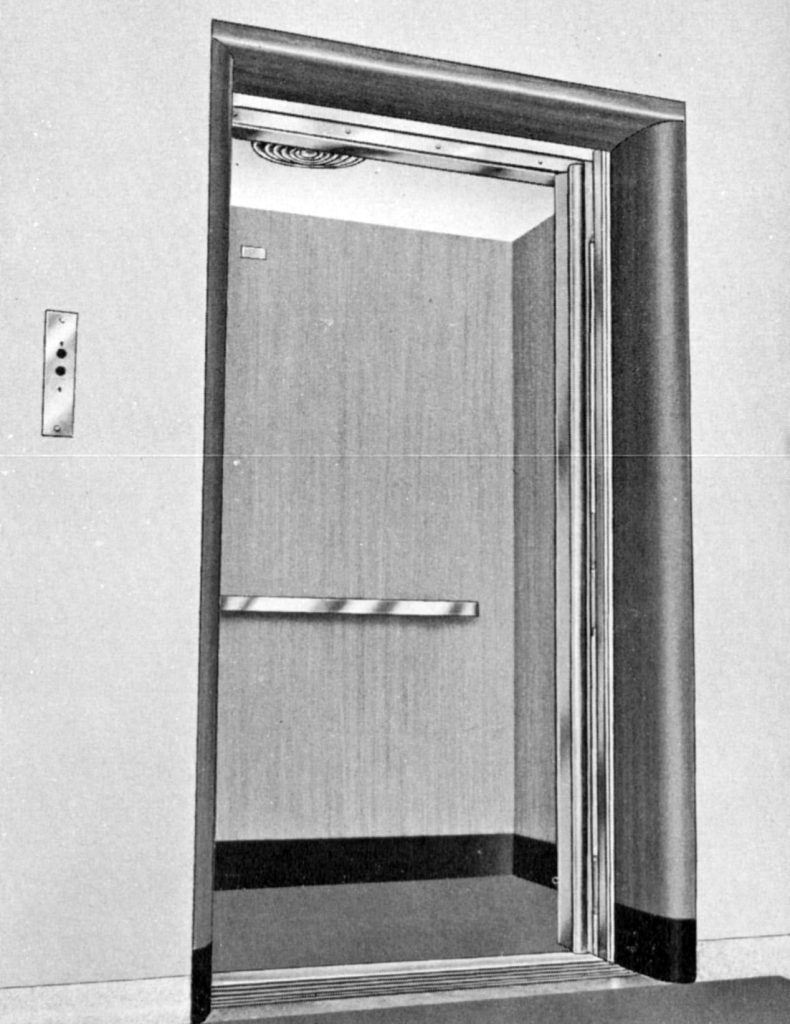
ESCO's standard passenger elevator had an operating speed of 150 ft/min and a height limit of 55 ft, automatic leveling and selective collective, cumulative or single automatic operating systems. Its capacity was somewhat ambiguously described as "to suit platform area" (Figure 4).[ 1 ] ESCO also manufactured passenger elevators designed for specific settings and uses. These included hospital, personnel and residential elevators. They claimed that "hospitals throughout the U.S. are using oil-hydraulic elevators because of their smooth operation and quiet performance."[ 1 ] These elevators featured "standard size hospital cars, wide hatchway doors and automatic leveling (to) facilitate handling stretchers."[ 1 ] Their "personnel elevator" was a somewhat unique product that was:
"Designed specifically for the use of executives and employees. It will conveniently handle six passengers, yet it is compact and requires a minimum of space for the hatchway. It has all the safety features and smooth riding qualities of a full-size passenger elevator, but for economy, swing type hatchway doors are recommended."[ 1 ]
While the rationale for this elevator is unknown, it remained a standard offering throughout the company's history, thus it presumably found a place in the corporate office marketplace. ESCO's residential elevator was described as having been developed "to meet a need for high class equipment in multi-story residences."[ 1 ] It was characterized as being "superior in many respects to other types of elevators for homes, being quiet and smooth in operation, neater in appearance, having automatic leveling and requiring less maintenance."[ 1 ]
18 VT Industry "Firsts"
A promotional brochure from the early 1960s listed 17 "ESCO innovations," all of which were claimed to be vertical-transportation (VT) industry "firsts." The list serves as a comprehensive summary of the company's progress in their development of the modern hydraulic elevator:
- First to use bronze guide liner in hydraulic elevator jack;
- First to use neoprene chevron packing;
- First to isolate car from plunger with cushioning neoprene;
- First to employ "tapered-thread" internal couplings for plungers;
- First to provide "self-centering" plungers — thus insuring alignment;
- First to design "tangential oil flow entry" for cylinder;
- First to use heavy duty (3000#) metal clad hose in oil line;
- First to use welded valve manifold (combining by-pass valve, lowering valve, leveling valve, relief valve and check valve in compact assembly);
- First to provide oil reservoir of curved contour (to reduce noise vibrations);
- First to provide electric valves with "piston" seats (for finer adjustment and smoother operation);
- First to provide pump unit enclosed in sound absorbing Celotex (metal clad);
- First Oil-Hydraulic elevator manufacturer to build full line of controllers;
- First to develop return line from packing gland to tank (eliminates oil leaks at packing);
- First to design selector in hatchway operated directly by the car;
- First to build drilling rig to work on car frame;
- First to design a hydraulic elevator for private residences; and
- First to design a hydraulic dumbwaiter for commercial use.[ 1 ]
By the mid 1960s the company had added an 18th ESCO first:
- First to provide two-way automatic leveling using separate motor, thus permitting the elevator to operate through the hatchway at leveling speed for maintenance and inspection.[ 2 ]
R&D Results in Patents
During the 1960s Loughridge continued his work with the company's R&D division, efforts that resulted in two additional patents, both of which concerned control systems. The rationale for the first patent included a summary of typical hydraulic elevator operation:
"It is of course desirable that a hydraulic elevator should accelerate smoothly and rapidly to operating speed when leaving a floor and decelerate smoothly and rapidly when approaching a floor. It should also accurately level itself at each floor and do all of these things effectively with varying elevator loads."[ 3 ]
This summary was followed by a predictable statement: "The hydraulic control valves and valve arrangements of the prior art, of which I am aware, have not proved to be entirely satisfactory for adequate accomplishment of these objectives."[ 3 ] Loughridge's patent concerned an improved control valve that met his stated objectives.
His second patent concerned "an improved up-control system for hydraulic elevators."[ 4 ] This effort involved a redesign of the system's by-pass valves:
"One of the most successful systems for controlling the speed of elevator cars travelling in an upward direction, particularly during leveling, utilizes one or more by-pass valves to divert the flow of fluid from the hydraulic jack or ram that propels the elevator car. The speed of the elevator is, of course, a function of the quantity or flow rate of the fluid which passes to the hydraulic jack. Thus, the by-pass valve is used to control the rate of fluid flow to the hydraulic jack. However, such systems controlled in accordance with the teachings of the prior art, of which I am aware, are subject to some disadvantages. For one thing, it is difficult to achieve a constant elevator speed during uplevelling. This problem is often the result of variations in system pressure due to variations in elevator load. That is, changes in elevator load alter the fluid pressure in the hydraulic jack and this pressure variation is not effectively reflected by the control system."[ 4 ]
Loughridge's bypass valve was designed to accommodate "pressure variations in the elevator jack," produce "constant up-leveling speeds independent of variations in elevator loads" and "provide a simplified up-leveling control system by decreasing the complexity of the principal components of the system."[ 4 ] His improved design "lead to increased economy by decreasing initial costs and maintenance problems."[ 4 ]
Los 1970s y 1980s
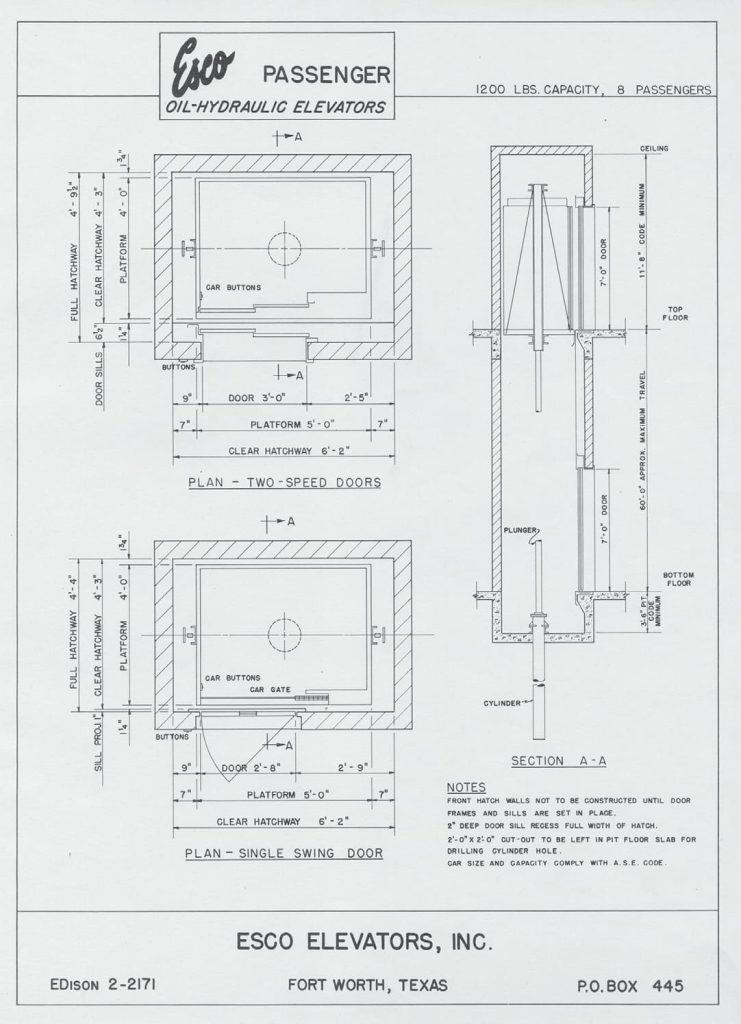
The systems and innovations described thus far formed the core of ESCO's product line throughout the company's history. The only exception was that production of the Levelift appears to have ceased by the early 1970s. This may have been due to safety concerns over the open platform design. Changes to other systems included replacing the personnel elevator's swing type hatchway door with a standard automatic sliding door system and gradually increasing operating speeds and height limits. By the mid 1970s, their passenger elevators were available in four standard sizes with capacities ranging from eight passengers (1200 lb) to 20 passengers (3000 lb). To assist architects and engineers in building design and planning ESCO, following typical industry practice, published detailed technical specifications (Figure 5).
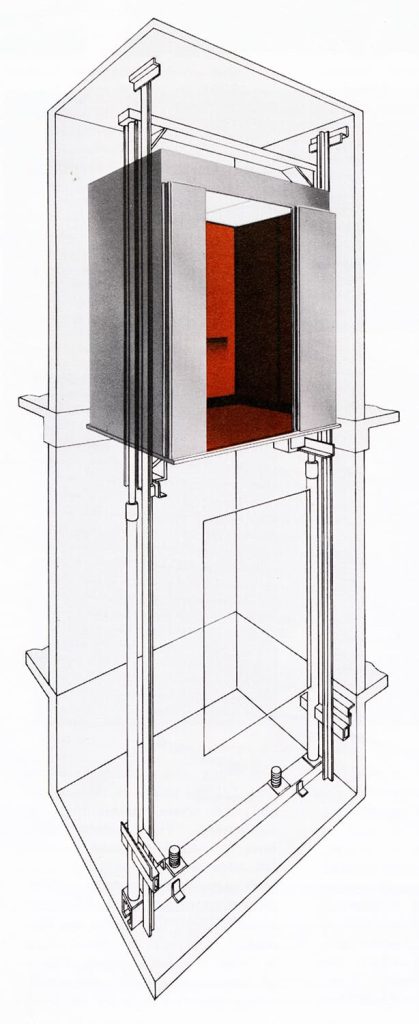
In the early 1980s, ESCO returned to a system they had briefly explored in the late 1950s: the holeless hydraulic elevator (Figure 6). Their new system, intended for use in new and existing buildings, was advertised in a perhaps, obviously "punning" fashion: "Don't let your hydraulic elevator construction projects go 'in the hole' from unnecessary drilling and extended installation periods. Simplify construction and assembly with a holeless hydraulic elevator from ESCO."[ 5 ] The new system operated in the "same size hoistway as a conventional hydraulic elevator." It was designed as a self-supporting unit with the vertical loads transmitted to the pit floor and with "only minor horizontal loads transmitted to the building structure." The design also employed standard ESCO components, including their standard jack units, guiderails, buffers and hoistway door assemblies. In keeping with their emphasis on simplicity of installation and maintenance, the controller was "mounted in a concealed compartment within the car." The elevator also featured a compact power unit that could be located "adjacent to or remote from the hoistway."
EW Founder Praises Loughridge
In 1982 ESCO moved into a new 190,000-ft² manufacturing plant, and the company's future appeared to be secure and on an upward trajectory. ELEVATOR WORLD founder Willian C. Sturgeon, in a 1984 interview with Loughridge, noted the latter's remarkable career:
"Bob, there are few, if any, executives in our industry who have guided one of the largest corporations non-stop for over 50 years. Otis has been absorbed by United Technologies; a half a dozen general managers have come and gone at Westinghouse; Rotary Lift has been absorbed by Dover; Haughton by Schindler; Armor by Kone, and U.S. Elevator by Cubic Corp. ... In the present top half dozen, Montgomery has remained a family business ... Your company, which must rank in seventh or eighth in volume, and only second to Dover in hydraulic volume, is unique in that you have headed it since its inception."
Loughridge was also clearly recognized as the driving force behind the company’s success. Regrettably, in 1987, he suffered a stroke that left him unable to continue leading the company he founded. The impact of his absence was exacerbated by the fact that he “had not arranged for an orderly transition of management and ownership.” Following his stroke, his wife, Anna Loughridge McMillian (1922-2010), assumed control of the company. The Fort Worth Star-Telegram’s announcement of this leadership change was decidedly optimistic — the article was titled “Outlook for ESCO Is on the Way Up.” However, the company soon entered a period of declining sales, and in 1992 it was sold to Texas businessman Richard (Dick) Davis, who had “made a career of turnarounds.” His past successes included the General Electrodynamics Corp., which made weighing instruments for aircrafts. However, Davis failed in his “turnaround” effort, and in 1995 the company was sold to a pair of Dallas investors, an action that was quickly followed by a declaration of bankruptcy. The Dallas investors hired Syed Zaidi, who “had owned companies that made computer printers and software,” to oversee the company’s rejuvenation.
Unfortunately, Zaidi’s efforts also failed, and ESCO declared a second and final bankruptcy in late 1997, and the company ceased operations in 1998.
While the unfortunate end of ESCO does not diminish the impact of Bob Loughridge’s remarkable career, it does serve as a reminder of critical topics that EW, throughout its history, has covered in numerous articles. These topics include the challenges of operating family-owned businesses and the importance of business continuity planning. The conclusion to the ESCO story also prompts questions about the nature of the VT industry in the last century and the need for further exploration of other VT companies — and the unique individuals — who led them.
Referencias
[ 1 ] ESCO Oil Hydraulic Elevators: Passenger and Freight, ESCO Elevators, Inc. (early 1960s).
[ 2 ] ESCO Oil Hydraulic Elevators: Passenger and Freight, ESCO Elevators, Inc. (mid 1960s).
[3] Robert F. Loughridge, Hydraulic Control Apparatus and Systems, U.S. Patent 3,141,386, filed January 15, 1962, and issued July 21, 1964.
[4] Robert F. Loughridge, Hydraulic Elevator Control Systems, U.S. Patent 3,266,382, filed September 24, 1964, and issued August 16, 1966.
[5] ESCO advertisement, MUNDO DEL ASCENSOR (Febrero 1980).
[6] Willian C. Sturgeon, “A Half Century of Leadership: Elevator World Interviews Robert F. (Bob) Loughridge,” EW (Febrero 1984).
[7] Dan Piller, “Death of Founder Leads to Chaos,” Fort Worth Star-Telegram (Abril 6, 1995).
[8] “Outlook for ESCO Is on the Way Up,” Fort Worth Star-Telegram (Febrero 23, 1988).
MÁS DE LA CATEGORÍA
NOTICIAS DIARIAS