
The Ministry of Science, Industry and Technology has published the “Elevator Industry Report 2023,” which contains information, data and assessments related to the elevator and escalator sector.
The report states that the Turkish elevator sector is an important area of activity for the country's industry, economy and employment due to its function and the fact that elevators are the most commonly preferred means of transportation. Along with new technologies developing around the world, the Turkish elevator sector has also undergone a major transformation process and has achieved significant market shares in world trade.
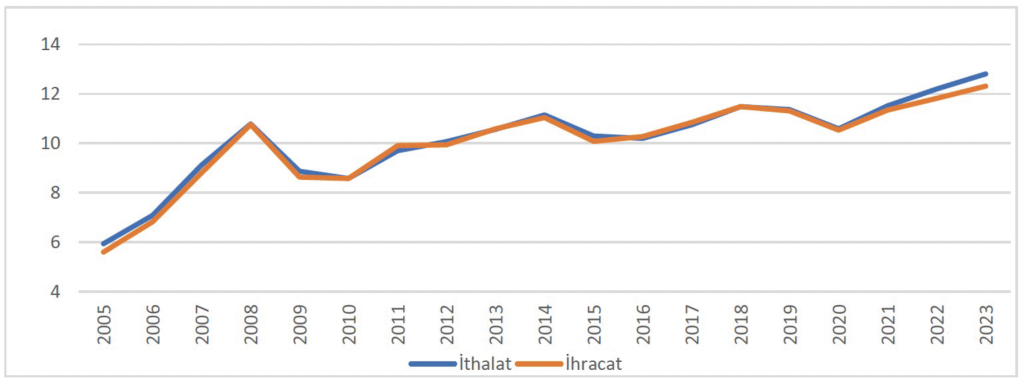
An analysis of the development of the global elevator sector shows that, as of 2023, it has reached a foreign trade volume of approximately US$25 billion, consisting of approximately US$12.3 billion in exports and US$12.8 billion in imports. Türkiye ranks eighth in exports with US$375 million, accounting for 3% of global exports.
As of 2023, 2,669 companies registered in the Industrial Registry Information System operating in the sector provide employment to 31,107 people. Furthermore, at the end of 2023, the number of Type A Inspection Organizations authorized by our Ministry for periodic elevator inspections was 39, while the number of companies holding the Service Competence Certificate issued by the Turkish Standards Institute for elevator maintenance and service was 3,098.
Considering factors such as the pace of urbanization in Türkiye and the need to construct new earthquake-resistant buildings to replace existing structures, it is anticipated that the growth in the elevator sector will continue in parallel with the activities of the construction sector. However, innovation and R&D activities, which need to be developed, are of great importance for the future perspective of the sector.
The Global Situation
When examining the development of the global elevator industry over the years (Figure 1), it is seen that the total foreign trade volume of the industry reached US$25.1 billion in 2023. Of this amount, US$12.3 billion was exports and US$12.8 billion was imports.
| Rank | Countries | 2019 | 2020 | 2021 | 2022 | 2023 |
| 1 | China | 23% | 22% | 24% | 25% | 25% |
| 2 | Italy | 10% | 10% | 10% | 9% | 10% |
| 3 | Spain | 10% | 9% | 9% | 10% | 9% |
| 4 | Germany | 9% | 9% | 8% | 7% | 7% |
| 5 | Slovakia | 4% | 6% | 6% | 7% | 6% |
| 6 | Netherlands | 5% | 5% | 5% | 5% | 6% |
| 7 | USA | 3% | 3% | 3% | 3% | 3% |
| 8 | Türkiye | 2% | 2% | 3% | 3% | 3% |
| 9 | France | 3% | 3% | 3% | 3% | 3% |
| 10 | Sweden | 3% | 3% | 3% | 3% | 3% |
Table 1. Leading countries in elevator exports and their share of exports (2019-2023, %)
China, Italy and Spain are among the leading countries in global elevator exports (Table 1). China continues to lead in global export share, with a 25% share in 2023. Türkiye ranks eighth in global elevator exports, accounting for 3% of global exports.
| Rank | Countries | 2019 | 2020 | 2021 | 2022 | 2023 |
| 1 | Germany | 7% | 8% | 8% | 7% | 7% |
| 2 | USA | 6% | 6% | 6% | 6% | 7% |
| 3 | France | 4% | 5% | 6% | 5% | 6% |
| 4 | Netherlands | 4% | 4% | 4% | 5% | 5% |
| 5 | United Kingdom | 5% | 5% | 5% | 5% | 5% |
| 6 | Italy | 3% | 3% | 3% | 4% | 4% |
| 7 | Canada | 3% | 3% | 3% | 3% | 4% |
| 8 | Switzerland | 3% | 3% | 3% | 3% | 3% |
| 9 | Spain | 3% | 3% | 3% | 3% | 3% |
| 10 | Saudi Arabia | 2% | 2% | 2% | 2% | 2% |
| … | ... | ... | ... | … | … | … |
| 34 | Türkiye | 1% | 1% | 1% | 1% | 1% |
Table 2. Leading countries in elevator ımports and their shares in ımports (2019-2023, %)
Looking at the leading countries in global elevator imports and their shares (Table 2), Germany, the U.S. and France rank in the top three. Türkiye ranks 34th with a 1% share of imports.
While the sector's exports were largely to Middle Eastern countries in the early 2000s, the export market has expanded further since 2013, primarily to Russia, and since 2019, primarily to Algeria (Figure 2). In 2023, the countries with the highest increase in exports were Russia (US$75 million), Algeria (US$33 million) and Iraq (US$20 million). A detailed analysis of the data shows that exports to a large number of countries indicate that the potential export network has developed considerably. The sector exported elevators to 68 countries in 2005, while this number rose to 144 countries in 2023.
The Situation in Türkiye
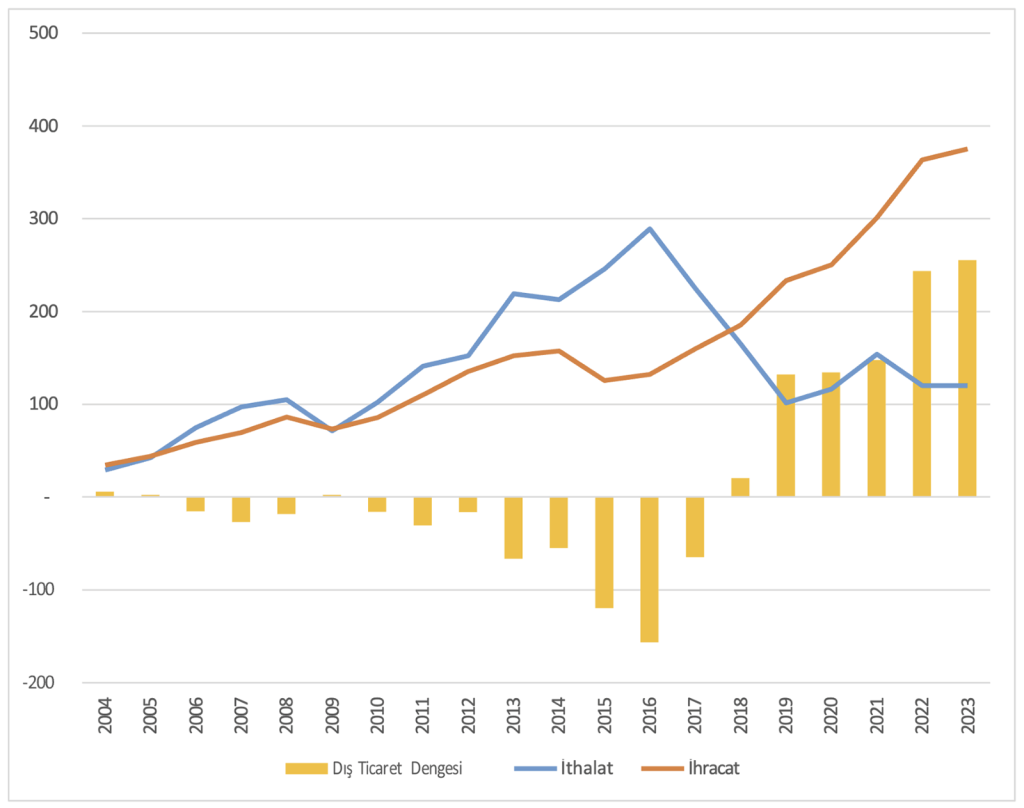
When examining the development of Türkiye's elevator sector's foreign trade over the years (Figure 4), it is seen that imports declined and exports increased as of 2016. Furthermore, since 2018, the sector has transitioned to a structure with a foreign trade surplus. One of the main reasons for this development is that elevators have become the most common means of transportation with the increase in construction in our country, and consequently, the demand for domestic production has risen. In particular, the growing need for housing and the growth in the construction sector have increased the effectiveness of domestic producers in the market and reduced dependence on foreign countries. In addition, Türkiye's adoption of a regulatory system harmonized with the European Union has enabled domestic producers to develop products that comply with international standards, thereby increasing export potential.
The Turkish elevator sector has shown steady growth in recent years, driven by increasing urban transformation projects, high construction activity, and developments in export potential. Production activities include fully automatic elevator systems for residential, commercial and industrial buildings, as well as vertical-transportation solutions such as disabled platforms, escalators and moving walkways.
The sector mainly produces electric elevators, hydraulic systems, rails, ropes, floor and cabin doors, cabins, control panels and elevator safety components. Domestic manufacturers are increasing their competitiveness both in the domestic market and in exports by complying with international standards. In line with technological developments, the production of energy-efficient products equipped with smart systems is coming to the fore.
The Turkish elevator sector is geographically concentrated in large cities and has developed most in the Marmara Region. Istanbul, Ankara and Izmir constitute the largest markets in the sector, while Izmir in the Aegean Region and Ankara and Konya in the Central Anatolia Region are important production centers.
Number of Workplaces and Employment
Based on the 2023 data from the Annual Operating Schedule submitted to the Industrial Registry Information System of the Ministry of Industry and Technology by elevator installation companies and elevator component manufacturers, as required by the Industrial Registry Law No. 6948, it is seen that there are 2,669 companies operating in the sector
(Table 3). Furthermore, at the end of 2023, the number of Type A Inspection Organizations authorized by our Ministry for periodic elevator inspections was 39, while the number of companies holding the Service Competency Certificate issued by the Turkish Standards Institute for maintenance and service of elevators was 3,098.
| PRODTR | Product | Number of Companies | Employment |
| 28.22.16.30.00 | Elevators and skip hoists (Electric operated) | 2.278 | 21.877 |
| 28.22.16.50.00 | Elevators and skip hoists (excluding electrically except those powered by electricity) | 69 | 967 |
| 28.22.19.50.00 | Elevators, skip hoists, and parts of escalators | 322 | 8.263 |
| Total | 2.669 | 31.107 |
Table 3. Number of companies and employment in the elevator sector (2023); source: Ministry of Industry and Technology, Industrial Registry Information System
Turnover
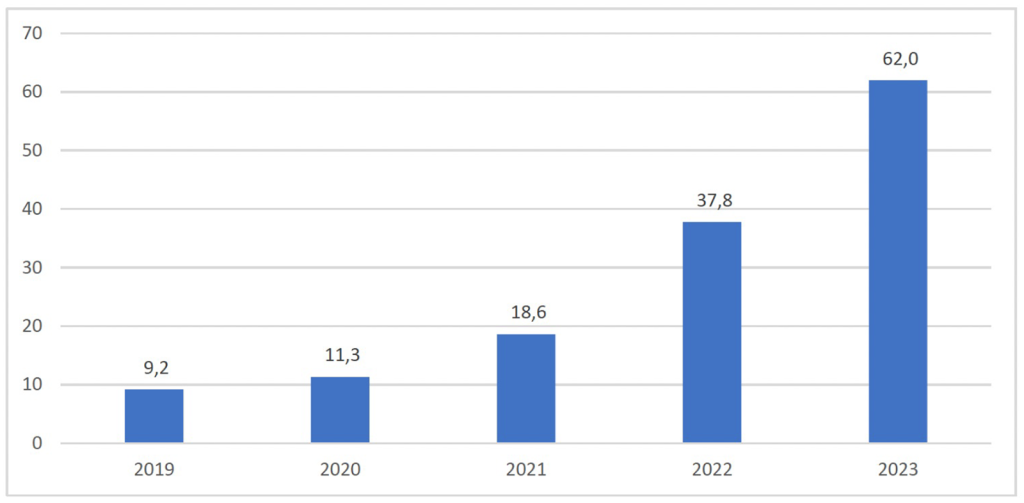
The turnover values of the lifting and handling equipment sector, which also includes the elevator sector, for the years 2019-2023 are shown in Figure 6. According to this, the sector's turnover reached TRY62 billion in 2023 and has been steadily increasing over the last five years.
Foreign Trade
Türkiye's elevator sector exports reached US$375 million in 2023, showing significant growth with an increase of US$249 million between 2015 and 2023. The sector's imports decreased by approximately US$188 million between 2016 and 2019. The increase between 2019 and 2021 has turned into a downward trend in the last two years. In 2023, the countries with the highest imports were China (US60 million), Italy (US16 million) and Slovakia (US12 million).
As a result, as of 2023, the sector has maintained its growth trend in terms of production value, export volume and employment indicators. In particular, the increase in domestic production capacity and the expansion of exports to a wider geographical area are increasing Türkiye's competitiveness in the global market. With its trade surplus structure, the sector is reducing its dependence on imports while further strengthening its export potential thanks to its capacity to develop products in line with international standards.